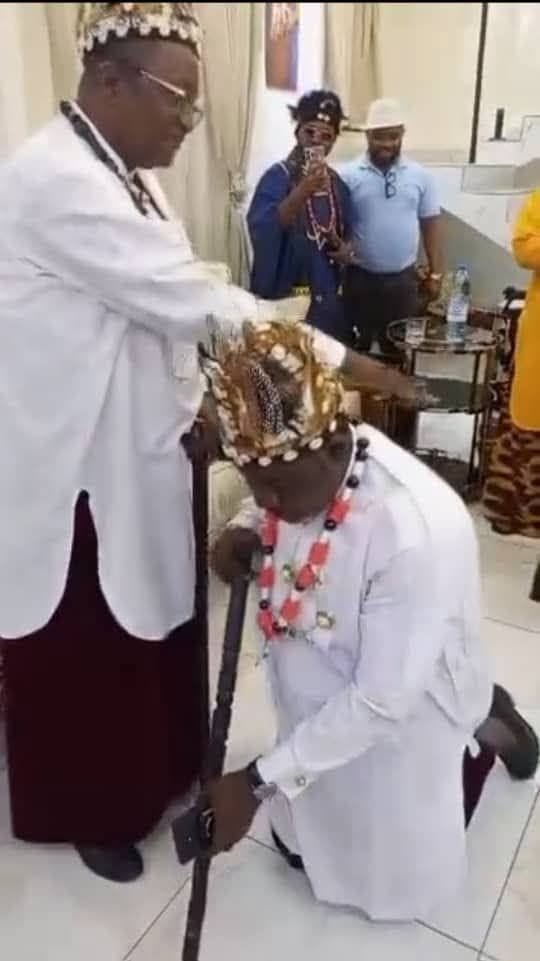
An image emerging from Manyu County in Ambazonia has ignited widespread debate and concern, not merely because it features the notorious colonial administrator Bernard Okalia Bilai, but because it captures a respected Manyu traditional ruler kneeling before him.
For many Ambazonians, the photograph represents far more than a ceremonial gesture. It raises profound questions about the current state of traditional authority under the occupation system imposed by La République du Cameroun and the increasing subordination of ancestral institutions to administrative power.
For years, traditional rulers across Ambazonia have found themselves trapped between two powerful forces. On one side are communities devastated by war, displacement, military violence, and economic hardship. On the other hand stands a regime determined to enforce loyalty through administrative control, intimidation, rewards, suspensions, and, in some cases, the replacement of non-compliant chiefs.
Several traditional rulers have fled their ancestral lands because of the conflict. Others have faced threats from armed actors. Yet many have also come under enormous pressure from colonial administrators who expect public displays of allegiance to the Yaoundé regime.
The image from Manyu, therefore, carries a symbolism that extends beyond personal respect or protocol. It reflects what many observers see as the gradual erosion of the moral and cultural authority that traditional rulers are expected to embody and defend.
Traditionally, chiefs are not ordinary political actors. They are custodians of culture, guardians of ancestral lands, protectors of communal memory, and symbols of their people’s dignity and identity. Their legitimacy does not originate from administrative appointments or government decrees. It comes from the communities that recognise them as custodians of their heritage and collective destiny.
That is why the image has resonated deeply across Southern Cameroons. To many, it appears to depict not simply respect for an officeholder but the symbolic submission of inherited traditional authority to an appointed representative of a government widely viewed as an occupying force in Ambazonia.
Defenders of the ceremony may point to development projects, road construction, and other state initiatives as justification for the gesture. However, critics argue that infrastructure development should never serve as the basis for traditional institutions to surrender their symbolic independence and cultural authority.
While some chiefs in Manyu may interpret the act as a sign of honour or appreciation, many Southern Cameroonians see it differently. They see a painful image of traditional authority bending at a moment when communities desperately need it to stand firm as a source of identity, dignity, and leadership.
The photograph has therefore become more than a snapshot from Manyu. It has evolved into a powerful symbol of the growing struggle over who truly commands authority in Southern Cameroons: the people and their ancestral institutions, or the administrative machinery of La République du Cameroun.
By Lucas Muma – BaretaNews