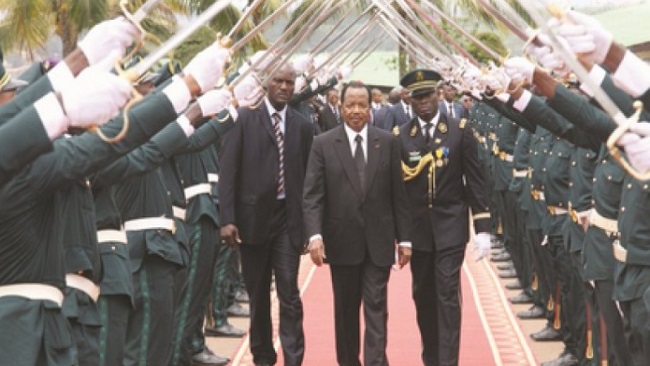
President Paul Biya has again reshuffled senior military commanders while governing from Geneva. The timing has renewed debate over the stability of his administration. It has also intensified questions about succession, military loyalty, and the future direction of the Cameroonian state.
Frequent changes at the top of the armed forces often serve several purposes. They can reward loyal officers, rotate commanders, and prevent any single faction from accumulating excessive influence. Critics, however, argue that repeated reshuffles may also reflect leadership anxiety during periods of political uncertainty.
Since the beginning of 2026, Biya has issued numerous decrees affecting the defence and security establishment. Observers point to the pace of these appointments as evidence that military affairs remain a priority. Whether they represent routine management or heightened concern over internal stability remains open to interpretation.
Cameroon also faces complex security challenges. The conflict in the North-West and South-West Regions continues to place heavy demands on the armed forces. At the same time, threats in the Far North and other security concerns stretch military resources across multiple fronts.
These pressures have inevitably affected morale within sections of the security establishment. Analysts and opposition figures have argued that differing views exist among officers over strategy, leadership, and the country’s political future. However, the extent of those divisions is difficult to verify publicly because the military remains highly closed to outside scrutiny.
The prolonged conflict in the Anglophone regions has become one of the defining challenges of Biya’s presidency. Years of fighting have produced no decisive military outcome. Instead, the conflict has evolved into a prolonged security and political crisis. That reality has prompted continuing debate over whether military measures alone can resolve the situation.
Meanwhile, Biya’s extended stay abroad has added another layer of uncertainty. Although the presidency insists that government business continues uninterrupted, critics argue that prolonged governance from outside the country weakens public confidence in state institutions.
History shows that military reshuffles alone rarely resolve deeper political problems. Lasting stability depends not only on command appointments but also on public trust, institutional strength, and political legitimacy. Until those broader questions are addressed, every new decree is likely to generate fresh speculation about the state of Cameroon and its leadership.