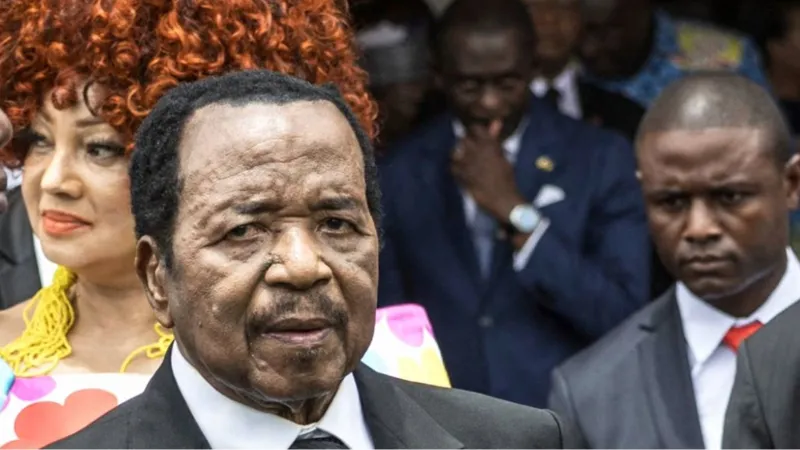
Paul Biya has reshuffled the military command of La République du Cameroun while remaining outside the country. The latest decrees have intensified debate over his prolonged absence from Ground Zero and the growing leadership vacuum inside French Cameroun.
The 93-year-old ruler signed the decrees on Monday, August 3, from Geneva, Switzerland. He has remained outside the country since June 7, despite officials initially describing the trip as a brief private visit. Nearly two months later, he has still not returned.
The most significant decree concerns the Presidential Guard. Under Decree No. 2026/265, Brigadier General Raymond Jean Charles Beko’o Abondo retained command of the elite force protecting Biya. He has led the Presidential Guard since 2013 and immediately resumed the strategic position after his promotion.
Earlier, Decree No. 2026/263 promoted five colonels to Brigadier General. They include Raymond Jean Charles Beko’o Abondo, Eloundou E. Mesmin Magloire Aristide, Nchankou Mbouombouo Njindam Oumar, Epie Ngome Wilson, and Mezui Zo’o Elie Romance.
Meanwhile, Decree No. 2026/264 reshaped the broader military command. Major General Ebaka Hippolyte became Chief of the General Staff of the Armed Forces. In addition, Biya appointed new commanders for the country’s four Joint Military Regions.
Although military reshuffles frequently occur under the Biya regime, this one carries greater political weight. His continued absence has raised questions about who truly controls state affairs.
The pattern is familiar. Following the military coup that removed Gabon’s Bongo dynasty three years ago, Biya quickly reorganised his military hierarchy. He repeated similar exercises during his controversial eighth presidential bid and again in June this year through fresh promotions across the defence forces.
However, this latest reshuffle comes amid unprecedented scrutiny. Every decree issued from Geneva deepens public concern over the regime’s stability and Biya’s ability to govern from abroad.
The Yaoundé regime insists the ageing ruler remains fully in charge. Communication Minister René Emmanuel Sadi recently told RFI that Biya is alive, working from Geneva, and will soon return. He also rejected opposition claims that the presidency has become vacant.
Nevertheless, many observers remain unconvinced. Since leaving French Cameroun, Biya has signed several decrees, including authorisations for international loan agreements. Yet he has failed to appoint the new cabinet he promised after last year’s disputed presidential election. Likewise, the newly created office of Vice President remains vacant months after its establishment.
Opposition voices argue that the prolonged absence has created a dangerous institutional vacuum. CRM Vice President Mamadou Mota recently declared that executive power must operate from within the nation, not from hotel rooms abroad.
Furthermore, speculation over Biya’s health continues despite repeated government denials. Officials insist he has not been hospitalised. However, secrecy surrounding his condition has only fuelled more rumours. Press freedom advocates also continue condemning restrictions that prohibit Cameroonian media from reporting on the president’s health.
For many observers, the latest military appointments extend beyond routine administration. Instead, they reflect a regime seeking to reassure loyalists while confronting mounting uncertainty over succession, stability, and the future of French Cameroun.
By Lucas Muma | BaretaNews


