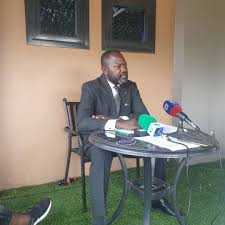

In a bold and calculated legal move shaking the foundations of the ongoing war in Ambazonia, Barrister Joseph Awah Fru, Lead Counsel for Ambazonian Prisoners of Conscience and War, has issued a powerful press statement demanding urgent action from the regime in Yaoundé. The statement, dated April 27, 2026, aligns with and reinforces the recent open letter by Professor Willibroad Dze-Ngwa, signalling a growing convergence of elite Ambazonian voices calling for a decisive shift.
Coming in the wake of the apostolic visit of Pope Leo XIV, Barrister Fru argues that a rare moral and political opportunity has emerged for genuine dialogue. According to him, this moment must not be wasted, as it presents a unique opening to address the root causes of the war in the former British Southern Cameroons.
At the heart of the statement lies a direct challenge to President Paul Biya and the occupying regime of La République du Cameroun. Barrister Fru places the full responsibility for de-escalation squarely on the State. He makes it clear that the power imbalance is undeniable. While Yaoundé commands a standing army, Ambazonian detainees held in Kondengui and other colonial prisons have no such control. From their cells, they cannot order ceasefires or influence armed actors on the ground.
The legal heavyweight identifies the unconditional release of all Ambazonian detainees as the first and most critical confidence-building step. He highlights emblematic cases that have come to define the injustice faced by the people of Ambazonia. Tsi Conrad has spent 3,422 days in detention. Penn Terrence has endured 3,384 days. Mancho Bibixxy has remained behind bars for 3,382 days. These prolonged detentions, Barrister Fru reminds the world, have been ruled illegal three times by the United Nations Working Group on Arbitrary Detention.
Beyond the immediate call for release, the statement reopens the historical wound of 1961. Barrister Fru calls on the United Nations to complete what he describes as a failed decolonisation process, referencing UN General Assembly Resolution 1608. For many in Ground Zero, this is the core of the crisis. Without addressing it, any attempt at peace remains fragile and temporary.
The statement further outlines a clear 30-day action framework aimed at halting hostilities and building trust. Under this proposal, the regime in Yaoundé is expected to announce the unconditional release of all detainees, declare a 90-day halt to military offensives, and invite the United Nations and African Union to co-convene structured talks. On the Ambazonian side, leaders are expected to reciprocate with a 90-day cessation of attacks and commit to dialogue without preconditions. The plan also calls for international supervision by a joint UN-AU envoy, alongside the deployment of human rights and ceasefire monitors across the territory.
In one of the most striking lines of the statement, Barrister Fru redefines the meaning of peace. He insists that peace is not the silence of guns alone but the presence of justice and representation. He warns that as long as children cannot safely attend school and mothers cannot freely vote, the conditions for war will remain alive.
As Ambazonia marks over 3,065 days since the war of liberation erupted in 2017, this latest intervention stands as both a legal indictment and a roadmap. For Barrister Fru and many on Ground Zero, these demands are not concessions. They are the minimum threshold required to restore dignity, rebuild trust, and give peace a real chance.