
A Legal Bombshell or a Path to Peace? Barrister Fru’s Intervention Reframes the Ambazonian Crisis
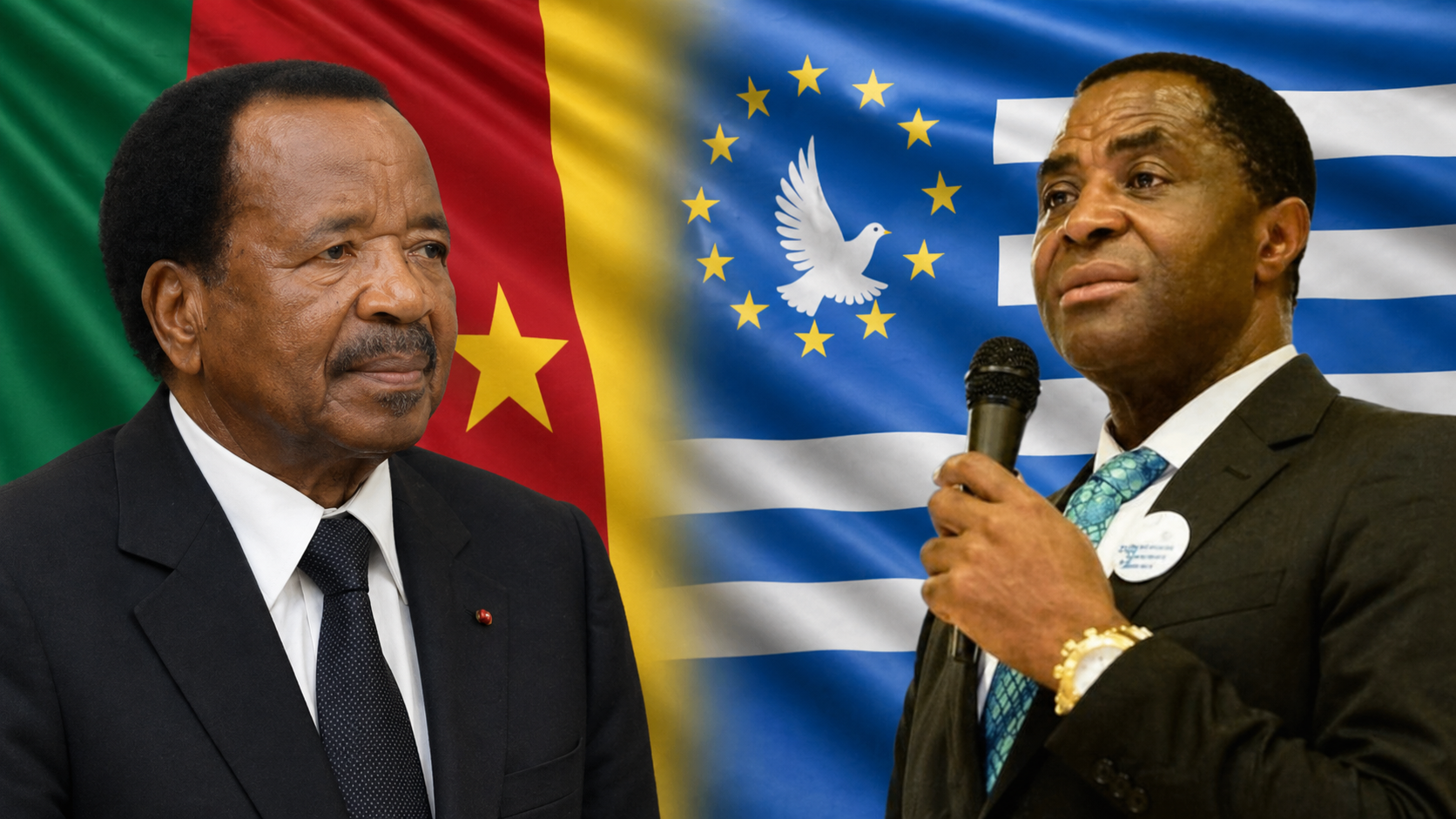
In a sharply worded press statement and a detailed joinder to Professor Willibroad Dze-Ngwa’s open letter, Barrister Joseph Awah Fru has inserted a forceful legal and moral argument into the already complex Southern Cameroons crisis. His intervention is not merely supportive—it is strategic, calculated, and aimed at shifting both responsibility and urgency squarely onto the State.
At a time when diplomatic signals—particularly the recent moral appeal linked to Pope Leo XIV’s visit—have revived conversations around dialogue, Fru’s message is clear: peace cannot begin where justice is absent, and justice cannot emerge while voices remain imprisoned.
Reframing Responsibility: “The Onus Is on the State”
One of the most striking elements of Fru’s position is his insistence on asymmetry of responsibility. In his words, the burden of initiating de-escalation lies with President Paul Biya and the Cameroonian State.
This is not rhetoric—it is a legal argument grounded in command responsibility. Fru draws a sharp distinction between a sovereign government commanding a structured military and detainees held in Kondengui who, as he notes, “command nothing.”
This framing challenges a long-standing narrative of “both sides must act equally”, instead asserting that power dictates duty. It is a perspective that could resonate strongly within international legal and diplomatic circles, particularly those concerned with proportionality and state accountability.
The United Nations and the Unfinished Question of 1961
Perhaps the most politically sensitive aspect of Fru’s intervention is his direct call on the United Nations to “complete the botched decolonization of 1961.”
This is not a new argument within Ambazonian discourse, but Fru elevates it with legal precision. By referencing UN General Assembly Resolution 1608 (XV) and the absence of a registered treaty of union, he reopens a foundational question:
Was the union between Southern Cameroons and La République du Cameroun ever legally concluded?
If taken seriously, this argument does more than critique governance—it questions the legitimacy of the current state structure itself. For the UN, long accused of silence on this issue, Fru’s call is a direct challenge to revisit a historical process many would prefer remain closed.
Prisoners as the Core Confidence-Building Measure
Fru’s most urgent demand is unambiguous: the unconditional release of all crisis-linked prisoners.
He frames this not as a concession, but as a precondition for dialogue.
This position aligns with findings from international human rights bodies, including repeated rulings that certain detentions violate international law. But Fru goes further—he argues that negotiations without legitimate representatives are inherently flawed.
His logic is difficult to dismiss: you cannot negotiate peace while silencing those expected to enforce it.
Redefining Peace: Beyond Silence of Guns
In a powerful conceptual shift, Fru rejects the traditional definition of peace as merely the absence of violence.
Instead, he offers a more demanding standard: peace as “representative power.”
He grounds this in everyday realities—children unable to attend school, mothers unable to vote—arguing that a ceasefire without structural change is merely a pause, not a solution.
This reframing challenges both national and international actors who may be tempted to prioritise short-term stability over long-term justice.
A 30-Day Action Framework: Practical or Aspirational?
Unlike many legal statements, Fru’s intervention does not stop at critique. He proposes a clear, time-bound framework:
- Government: release prisoners and pause military operations
- Southern Cameroons leadership: declare a ceasefire and commit to talks
- UN/AU: appoint an envoy and oversee the process
The clarity of this proposal is notable. However, its feasibility remains uncertain.
The Cameroonian government has historically resisted internationalisation of the crisis, while separatist factions remain fragmented. The question, therefore, is not whether the plan is logical—it is whether the political will exists to implement it.
A Voice Rooted in Law, Speaking to Power
What distinguishes Fru’s intervention is its tone: firm, legally grounded, and unapologetically direct.
He does not romanticise the crisis, nor does he dilute its complexities. Instead, he strips the conversation down to fundamentals—law, responsibility, and legitimacy.
His closing line captures the essence of his argument: “These are not surrenders. They are the law. They are the minimum.”
Conclusion: A Moment That Demands Decision
Barrister Fru’s statement may not immediately change realities on the ground. But it does something equally important—it reshapes the terms of the debate.
By centring law over politics, responsibility over symmetry, and justice over silence, he forces all actors—state, separatists, and international community alike—to confront uncomfortable questions.
The timing is critical. With renewed global attention and moral pressure following recent diplomatic engagements, the window for meaningful intervention may be narrow.
Whether this moment leads to genuine dialogue or fades into another missed opportunity will depend on one thing above all: who is willing to move first—and whether the law will finally be allowed to lead.