
“Peace Cannot Be Reduced to a Slogan”: Pope Leo’s Yaoundé Message and the Reality of the Ambazonian Conflict
By James Agbor for BaretaNews
The words of Pope Leo in Yaoundé today have once again drawn global attention to the protracted crisis in Southern Cameroons—also known as Ambazonia. In a statement that resonated far beyond the ceremonial setting, the Pope declared: “Peace cannot be reduced to a slogan.”
For many in the Northwest and Southwest regions, this was not just a philosophical reflection—it was a direct commentary on a conflict where the language of peace has often outpaced the reality on the ground.
A Crisis Beyond Words
For nearly a decade, the people of Southern Cameroons have endured a brutal and complex conflict marked by displacement, insecurity, and deep political grievances. While official narratives frequently emphasize national unity and stability, critics argue that these declarations have not translated into meaningful change for affected communities.
It is within this context that the Pope’s additional remarks carry particular weight: “The strong call for justice and the deep desire for peace from these areas deserve quick and real action through honest dialogue.”
This statement reinforces a long-standing demand from Ambazonian voices—that the crisis is not merely a security challenge, but a political question rooted in identity, governance, and historical marginalisation.
The Question of Justice
By explicitly referencing “justice,” the Pope touched on one of the most sensitive dimensions of the conflict. For many in Southern Cameroons, justice is tied to issues ranging from perceived systemic discrimination to the right to self-determination.
While the Vatican’s position remains diplomatically neutral, such language implicitly validates the idea that peace cannot be imposed without addressing underlying grievances. It also places a moral obligation on all actors—state forces, separatist groups, and international stakeholders—to confront uncomfortable truths.
Violence and Responsibility
Equally significant was the Pope’s rejection of violence “whether from individuals or from institutions.” This balanced framing is critical in a conflict often defined by competing narratives of victimhood.
On one hand, separatist groups have been accused of enforcing school boycotts, kidnappings, and attacks on civilians. On the other, state security forces have faced longstanding allegations of excessive force and human rights violations.
By condemning violence in all its forms, the Pope avoided political alignment while reinforcing a universal principle: that the suffering of civilians cannot be justified under any cause.
Dialogue as the Missing Link
Perhaps the most consequential element of the Pope’s message lies in his insistence on “honest dialogue.” For many observers, this remains the missing piece in resolving the Ambazonian conflict.
Previous attempts at dialogue have often been criticised as superficial or exclusionary. Key stakeholders, particularly those seen as representing separatist interests, have frequently been absent or marginalised from formal processes. As a result, trust has eroded, and the conflict has persisted.
The Pope’s call reframes dialogue not as a symbolic gesture, but as an urgent necessity—one that must be inclusive, transparent, and rooted in good faith.
A Moral Voice in a Political Crisis
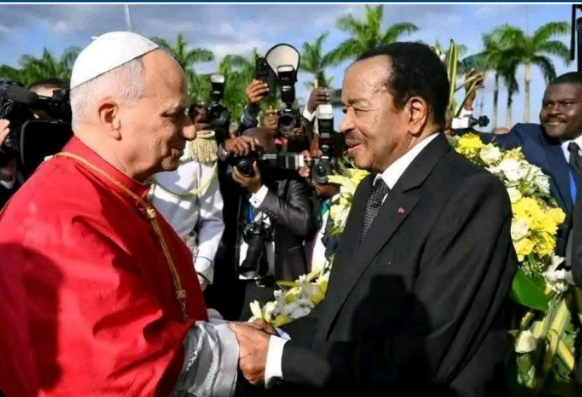
While Paul Biya was present during the address, the Pope’s message transcended the immediate political setting. It was, at its core, a moral intervention—one that challenges both rhetoric and inaction.
For Ambazonians, the statement “Peace cannot be reduced to a slogan” encapsulates a lived reality. Peace is not found in speeches or declarations, but in safety, justice, and dignity. Until these are realised, the word itself risks losing meaning.
What Comes Next?
The immediate impact of the Pope’s visit remains uncertain. Yet moments like this matter. They shape narratives, influence international perception, and, at times, create openings—however small—for renewed engagement.
For the people of Southern Cameroons, the message from Yaoundé offers both recognition and challenge: recognition that their suffering is seen, and a challenge to all parties to move beyond slogans toward substance.
In a conflict where trust is scarce and fatigue is widespread, perhaps the most enduring takeaway from today’s address is this: peace, if it is to last, must be built—not proclaimed.
BaretaNews will continue to follow developments in the Ambazonian struggle and the broader implications of today’s historic remarks.