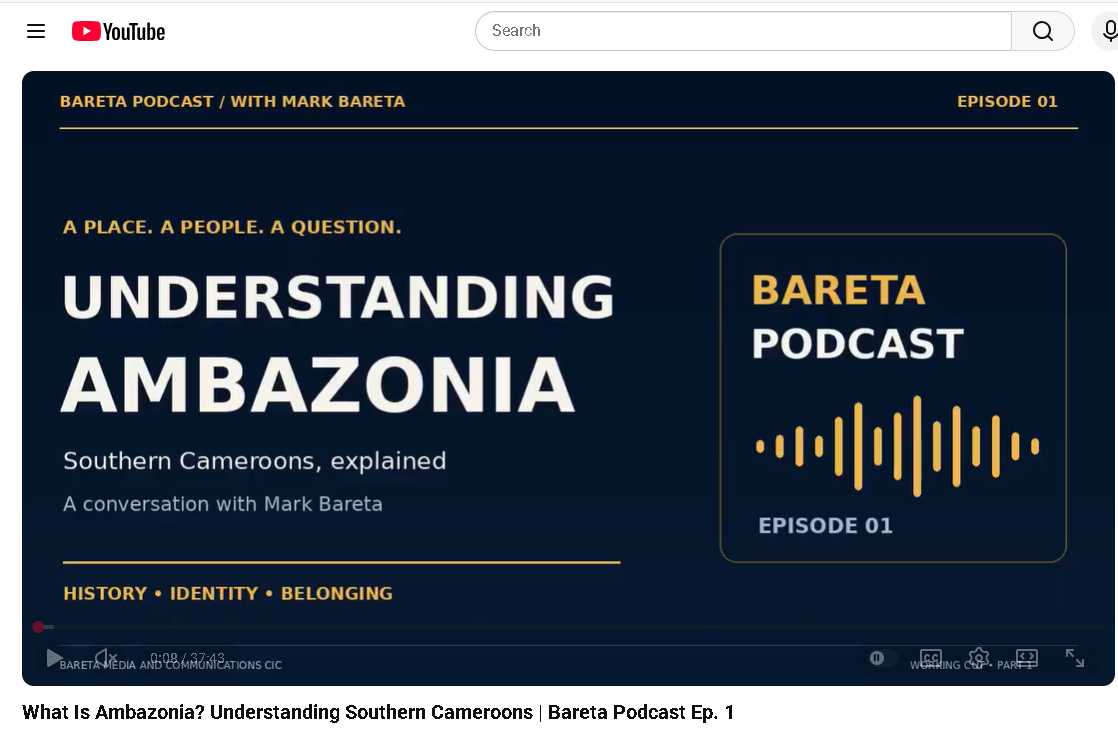
BaretaNews Editor-in-Chief Mark Bareta launches a new platform to revisit Southern Cameroons’ history, challenge internal divisions, amplify diverse voices, and document the struggle for future generations.
Watch it here: https://www.youtube.com/watch?v=PSWroctS-Cg
The Ambazonian struggle is entering another phase of public engagement as Mark Bareta, Editor-in-Chief of BaretaNews, launches the Bareta Podcast.
Known to many supporters as Abdul Malik Bar, Bareta has been a prominent voice in the Southern Cameroons struggle since its early years. His latest initiative aims to move the conversation beyond slogans and social media reactions to deeper discussions about history, political strategy, unity, and the future of Ambazonia.
The inaugural episode sets an analytical tone, revisiting the historical foundations of the Southern Cameroons question and examining the challenges confronting the movement today.
For Bareta, whose media work has helped shape online conversations about the struggle, the podcast represents another effort to document the people’s story and examine the choices that will influence its future.
From Digital Activism to Historical Documentation
Bareta’s journey in the movement has been closely connected to digital communication and citizen journalism.
BaretaNews traces its beginnings to 2008, when it started with social media posts before evolving through blogging into an online news platform. Over the years, it has covered political developments, human rights concerns, resistance activities, and debates surrounding Southern Cameroons and Ambazonia.
During the 2016 crisis, Bareta became a prominent online voice addressing the grievances of English-speaking communities and promoting the independence cause. His digital engagement helped bring the Southern Cameroons question to wider online audiences.
His work has also extended into publishing. In August 2018, he released The Never Again Generation: Bullets Versus Social Media, documenting the crisis’s early years.
In September 2026, he published an expanded second edition that extends the historical account through major developments up to that month. The book reflects his stated belief that people who experience major political events should document their experiences for future generations.
Bareta’s latest initiative builds on that record. While written publications preserve events in text, a podcast can bring history and political debate to life through spoken explanations, interviews, questions, and competing perspectives.
Revisiting History Beyond Slogans
One of the podcast’s central pillars is historical examination.
The inaugural episode revisits the transition from German colonial rule to British and French administration, followed by the 1961 United Nations-sponsored plebiscite and the subsequent constitutional arrangements.
These events remain central to competing interpretations of the political relationship between Southern Cameroons and La République du Cameroun.
By examining the historical record, the podcast can help listeners understand the dispute’s origins rather than encountering the conflict only through daily reports of violence, arrests, military operations, or political statements.
The challenge will be to present historical documents, legal arguments, and competing interpretations clearly. Such an approach can equip listeners to interrogate claims, understand the context, and engage more confidently in discussions about the future.
For younger Ambazonians, particularly those growing up amid the conflict, this could provide an accessible way to learn about the historical developments that shaped their society.
Unity, Accountability and Difficult Conversations
The podcast also confronts a difficult question within the Ambazonian movement: what does unity actually mean?
Political divisions, leadership disputes, and competing strategies have complicated efforts to set a common direction. Public debates can also become hostile when people question established positions or challenge influential figures.
The inaugural episode reportedly calls for greater internal accountability, broader participation, and space for dissent.
That discussion is important because unity cannot be sustained by slogans alone. It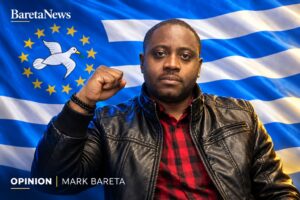 requires a willingness to confront disagreements, examine leadership decisions, and allow people to question strategies without automatically treating criticism as betrayal.
A podcast that creates space for these conversations could help listeners better understand the different positions within the movement. It could also encourage more constructive debate about representation, diplomacy, political organisation, and leadership responsibilities.
However, the platform’s credibility will depend on how consistently it applies these principles. A genuinely useful forum must welcome difficult questions, distinguish fact from opinion, and let arguments be judged on their merits.
Putting the Human Cost at the Centre
Beyond history and political strategy, the podcast focuses on the conflict’s human consequences.
Since 2016, civilians across Southern Cameroons have endured insecurity, displacement, disrupted education, business losses, and the pain of losing family members. Teachers, lawyers, students, and other community members have also faced serious pressures amid the prolonged crisis.
Political arguments about territory, sovereignty, leadership, or military strategy should not overshadow these communities’ suffering.
By giving greater attention to lived experiences, the podcast can help listeners understand how political decisions affect ordinary people. Interviews with affected families, educators, community leaders, human rights advocates, and other relevant voices could bring perspectives that are often missing from elite political discussions.
Such conversations would also help preserve testimony for future researchers and generations seeking to understand what happened to their communities.
Humanising the conflict does not require abandoning political analysis. Rather, it places people and their dignity at the centre of the discussion.
How the Podcast Could Benefit Listeners
The Bareta Podcast could become more than another channel for political commentary.
First, it can offer historical education by explaining key events, constitutional developments, and political decisions in accessible language.
Second, it can support critical thinking by encouraging listeners to question claims, examine evidence, and distinguish verified information from speculation.
Third, it can promote informed participation by helping Ambazonians understand the debates surrounding leadership, unity, diplomacy, and political strategy.
Fourth, it can preserve collective memory through recorded conversations with people who witnessed or participated in important events.
Finally, it can create space for constructive disagreement by bringing different perspectives into a structured conversation rather than leaving complex questions to fragmented social media exchanges.
These benefits will depend on the quality of the research, the diversity of guests, and the willingness to address uncomfortable questions. Consistent publication and responsible moderation will also be essential.
Reshaping the Ambazonian Narrative
For years, international attention surrounding Southern Cameroons has often focused on armed confrontations, civilian suffering, displacement, and allegations of abuses. These realities matter, but they do not capture every dimension of the people’s history, political aspirations, internal debates, or social life.
The Bareta Podcast could help broaden that picture.
A well-researched series can explain the historical arguments behind the independence movement, document the experiences of affected communities, examine political actors’ decisions, and scrutinise the strategies pursued in the name of Ambazonia.
It can also challenge simplistic portrayals of the population by presenting Ambazonians as people with diverse experiences, ideas, concerns, and visions for their future.
Reshaping the narrative, however, requires more than defending one political position. It requires credible documentation, factual accuracy, meaningful questions, and a willingness to confront evidence even when it challenges familiar assumptions.
If the podcast consistently meets these standards, it could help foster a more informed Ambazonian public conversation and provide journalists, researchers, policymakers, and diaspora members with a valuable record of the movement’s evolution.
Watch it here: https://www.youtube.com/watch?v=PSWroctS-Cg
By Lucas Muma l BaretaNews