By BaretaNews | Research Spotlight
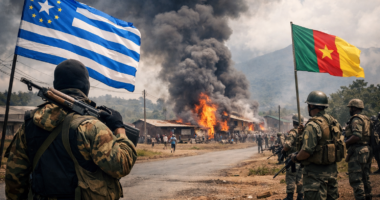
A Russian-language study published in 2021 argued that limited international backing and divisions within the Ambazonian movement weakened the prospects of achieving independence through armed struggle, increasing the importance of a negotiated settlement.
The paper, Separatism in South Cameroon: Sources and Prospects, was written by Tatyana S. Denisova and Sergey V. Kostelyanets. Alongside its assessment of the movement’s challenges, it examined the historical marginalisation of English-speaking communities and the role of state repression in the conflict’s escalation.
The main article was written in Russian, with an English abstract. BaretaNews is examining a study published in 2021, drawing on material from the preceding years. Its conclusions should therefore be read as the authors’ assessment at that time, rather than a new finding about conditions in 2026.
What the researchers concluded
Denisova and Kostelyanets identified a difficult international environment for the independence movement. In their assessment, the absence of substantial external financial and military support restricted the prospects of success through armed struggle.
They also described a fragmented movement, with organisations and armed groups pursuing different interests and competing for influence, resources and the right to represent English-speaking communities internationally. Their analysis connected these divisions with the difficulty of sustaining a coherent political and military strategy.
The authors’ conclusion pointed towards the importance of a peaceful agreement with the government. This was an analytical judgement about the prospects of the struggle; it was not evidence that negotiations had produced a settlement.
Historical grievances and state repression
The study did not explain the conflict solely through the actions of armed groups. It traced its roots to the different institutions and political traditions that developed under British and French administration, including differences in education, law and governance.
It examined the erosion of federal arrangements, the centralisation of power and the grievances of English-speaking communities over political representation and access to resources. Within that historical account, demands for autonomy and independence emerged from a longer dispute over the terms of the union.
The authors also discussed the repression of protests and its contribution to the escalation of the crisis. Their account considered the transition from the teachers’ and lawyers’ protests of 2016 to a wider confrontation and armed conflict.
Civilians at the centre of the cost
The paper discussed the suffering of civilians and abuses attributed to government forces and armed groups. It situated the conflict within a broader social and economic crisis, rather than treating military developments as its only measure.
For readers considering its conclusions, that civilian dimension matters: an assessment of political strategy cannot be separated from the consequences for families, communities and everyday life.
Who wrote and funded the study?
At publication, both authors were affiliated with the Institute for African Studies of the Russian Academy of Sciences in Moscow. Denisova was identified as a historian and head of the Centre for Tropical Africa Studies. Kostelyanets was identified as a political scientist and head of the Centre for Sociological and Political Science Studies, with an additional affiliation at the National Research University Higher School of Economics.
The funding acknowledgement names the Ministry of Science and Higher Education of the Russian Federation. The work formed part of the project Post-Crisis World Order: Challenges and Technologies, Competition and Cooperation, under agreement No. 075-15-2020-783.
That disclosure establishes the research’s stated funding connection. It does not, by itself, establish that the authors’ conclusions represent Russian government policy or an official diplomatic position on Ambazonia.
Reading the findings in context
The study offers an external academic interpretation of the conflict, including conclusions that supporters of independence may dispute. Its assessment of international support and internal divisions should be considered alongside its publication date and the evidence it used.
For BaretaNews readers, the central argument is clear: the researchers recognised historical grievances and repression while questioning whether armed struggle, under the conditions they examined, could deliver independence. Their analysis placed greater weight on a negotiated political outcome.
Source: Denisova, T.S. and Kostelyanets, S.V. (2021), Separatism in South Cameroon: Sources and Prospects, Outlines of Global Transformations: Politics, Economics, Law, 14(1), pp. 194–213. Published in Russian. Read the study via its DOI.
Editorial note: This article summarises the supplied research paper. It is not a full translation, a current battlefield assessment or an official Russian government statement.