
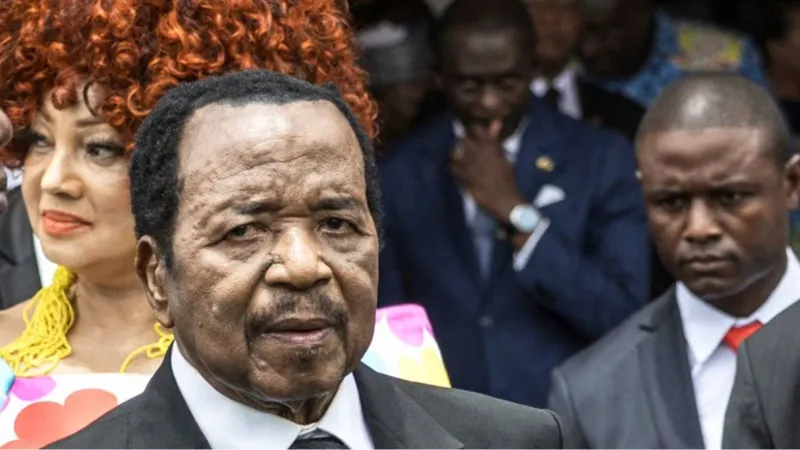

Bloomberg’s latest report exposes the financial risks of a political system built around one ageing ruler, with no publicly designated successor and mounting pressure on state finances. For Ambazonians, the crisis raises deeper questions about power, accountability, and the future of La République du Cameroun.
La République du Cameroun faces a fresh financial warning, and this time, international investors are pricing in its political uncertainty.
A Bloomberg report published on October 21, 2026, says investors are selling the country’s bonds following a credit downgrade. The market pressure comes as President Paul Biya, 93, remains at the centre of a succession question that Yaoundé has yet to resolve publicly.
The warning is significant. Fitch Ratings downgraded the country’s long-term credit rating from B to B− on October 16. The agency cited uncertainty surrounding the presidential succession and growing financing pressures.
For a government that increasingly depends on borrowing, this is more than a financial headline. It warns of the cost of keeping a country’s political future uncertain.
Investors Are Losing Confidence in Yaoundé
Bloomberg reported that yields on the government’s dollar-denominated bond maturing in 2033 climbed above 11% after five consecutive days of increases. The yield reached its highest level since the bond was issued in January 2026.
The country was also reported to be paying more to borrow than the Republic of Congo, despite Congo’s lower credit rating.
Investors have reasons to be cautious. When lenders perceive greater political or financial risk, they typically demand higher returns to compensate for that exposure.
That translates into a difficult choice for Yaoundé. It can accept more expensive financing, seek alternative funding sources, or scale back its borrowing plans. None of these options comes without consequences.
The downgrade also comes as the government faces growing financing needs. Fitch estimates gross financing needs could reach 7.3% of gross domestic product in 2026, compared with 5% in 2025.
The absence of a new International Monetary Fund programme adds another challenge. The previous arrangement ended in July 2025, leaving the government without a replacement agreement at the time of the latest reporting.
These pressures are not caused by presidential age alone. However, the absence of a clearly designated successor has become an additional risk that investors cannot ignore.
LRC Without a Clear Political Future
Paul Biya has ruled La République du Cameroun since 1982. He won another seven-year term in the disputed October 2025 presidential election, potentially keeping him in office until he is nearly 100.
At 93, he is the world’s oldest serving president. Yet the central issue is not his age in isolation. It is whether the institutions of the state can guarantee a predictable transition of power.
In April 2026, a constitutional amendment restored the office of vice-president. The position was abolished in 1972. Under the new arrangement, a vice-president would assume the presidency for the remainder of the term if the office became vacant.
However, no vice-president had been appointed in the reporting available for this article. The constitutional mechanism therefore exists, but the absence of a named officeholder leaves questions about the practical arrangements for succession.
This is the contradiction confronting Yaoundé. The authorities have amended the Constitution to address presidential succession, yet the public still lacks clarity on who would take over and how the transition would unfold.
Investors need not wait for a constitutional crisis to reassess their exposure. They price the risk in advance.
The Cost of Personalised Power
For decades, political authority in La République du Cameroun has remained concentrated around Biya and the ruling establishment.
This arrangement raises a fundamental institutional question: can a republic function predictably when its leadership’s future remains closely tied to one individual?
A modern state should not depend on speculation about its president’s health, whereabouts, or longevity. Its institutions should be strong enough to provide continuity regardless of who occupies the highest office.
Yet the succession uncertainty now reflected in the country’s credit rating exposes the consequences of leaving such a crucial question unresolved.
The problem extends beyond financial markets. Political uncertainty can shape investment decisions, government planning, public confidence, and businesses’ willingness to commit capital over the long term.
For ordinary citizens, expensive borrowing can become particularly troubling if financing pressures limit resources for public services and development. The ultimate impact depends on government choices, economic performance, and future borrowing terms.
But the broader warning is clear: political uncertainty can come at an economic cost.
By Lucas Muma l BaretaNews Editor


