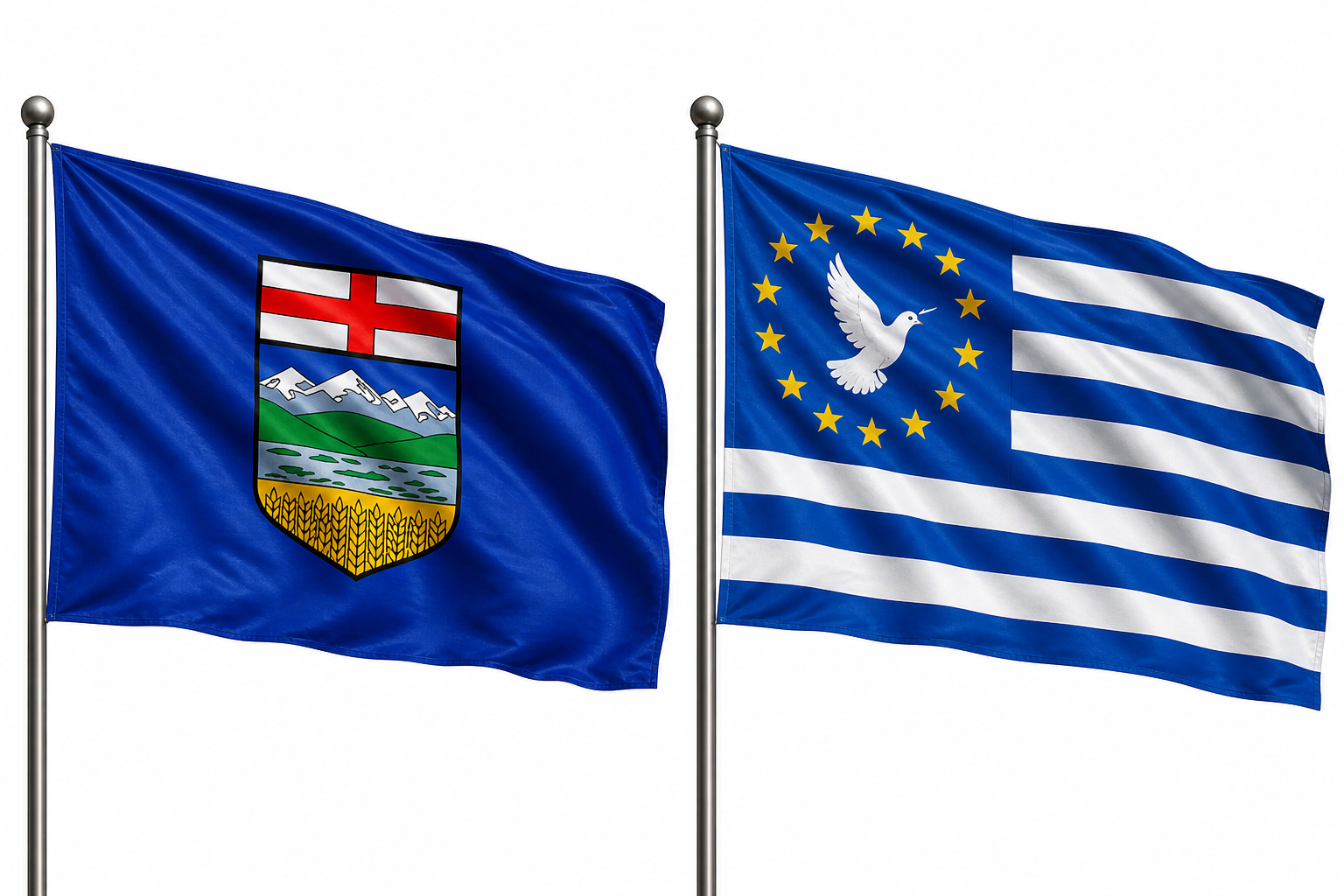

Alberta Referendum Push and What It Means for Ambazonia
Written by James Agbor for BaretaNews
The recent report by BBC News examines a growing separatist movement in Canada’s province of Alberta, where campaigners have submitted a petition calling for an independence referendum. According to the report, organisers claim to have surpassed the legal threshold of signatures required to trigger a vote, potentially setting the stage for a province-wide referendum. The development reflects rising political and economic dissatisfaction among some Albertans, particularly over federal policies affecting the region.
The BBC highlights that this push for independence is unfolding entirely within a legal and democratic framework. Rather than armed confrontation, proponents are relying on constitutional mechanisms—petitions, public debate, and the possibility of a referendum.
In Alberta, campaigners are pursuing independence through legal and democratic means. They have organised petitions, mobilised public opinion, and are working within Canada’s constitutional framework to push for a referendum. Crucially, there is no war. There are no armed confrontations between separatists and the Canadian state. Disagreements, however serious, are being channelled through institutions, courts, and political processes.
This stands in stark contrast to the situation in Cameroon, where the Ambazonian crisis has escalated into armed conflict between state forces and separatist fighters. Instead of ballots, the dominant reality has been bullets. Villages have been affected, civilians displaced, and trust between communities and the state severely damaged. This difference is not accidental—it reflects deeper structural and political realities.
The Alberta case teaches that legitimacy in today’s world is built through law, not force. Even if a referendum is granted, independence is not automatic; it would trigger negotiations, legal reviews, and complex constitutional processes. For Ambazonia, this exposes a key difficulty: there is currently no mutually accepted legal or constitutional pathway through which such a process can unfold. The breakdown of trust and the ongoing conflict make it extremely difficult to even begin that kind of structured dialogue.
Another lesson lies in unity and internal consensus. In Canada, despite divisions, the debate remains within a shared political system. In Ambazonia, fragmentation among factions and competing leadership claims weaken the movement’s ability to present a single, credible negotiating position. Without unity, even a legitimate cause struggles to gain international traction.
However, it must be acknowledged that applying the “Alberta model” to Ambazonia is not straightforward. Canada is a stable democracy with strong institutions, an independent judiciary, and established legal mechanisms for resolving disputes. Cameroon operates under very different conditions, where political grievances have not been effectively addressed through institutional channels, contributing to the escalation into violence. In such an environment, shifting from armed struggle to a purely legal process is far more difficult.
This raises a deeper and more uncomfortable question: why has war broken out in one context but not the other? Why are Canadians able to debate separation without violence, while in Cameroon the situation has descended into armed confrontation? Part of the answer lies in governance, institutional trust, and political culture. Where systems allow grievances to be expressed and negotiated peacefully, conflict is less likely to turn violent. Where those avenues are weak or absent, tensions can escalate.
It also prompts a broader reflection for African societies. Too often, political disputes escalate into conflict before meaningful dialogue is exhausted. The Alberta example shows that even serious questions about national unity can be handled without violence—through law, negotiation, and public participation. The challenge is not simply to compare contexts, but to ask what can be learned and adapted.
Ultimately, the lesson is not that Ambazonia can simply replicate Alberta’s path—it cannot, at least not under current conditions. Rather, the lesson is that sustainable outcomes are built on legitimacy, inclusive dialogue, and credible institutions. Until those elements are strengthened, the road to any lasting resolution in Ambazonia will remain far more difficult.


