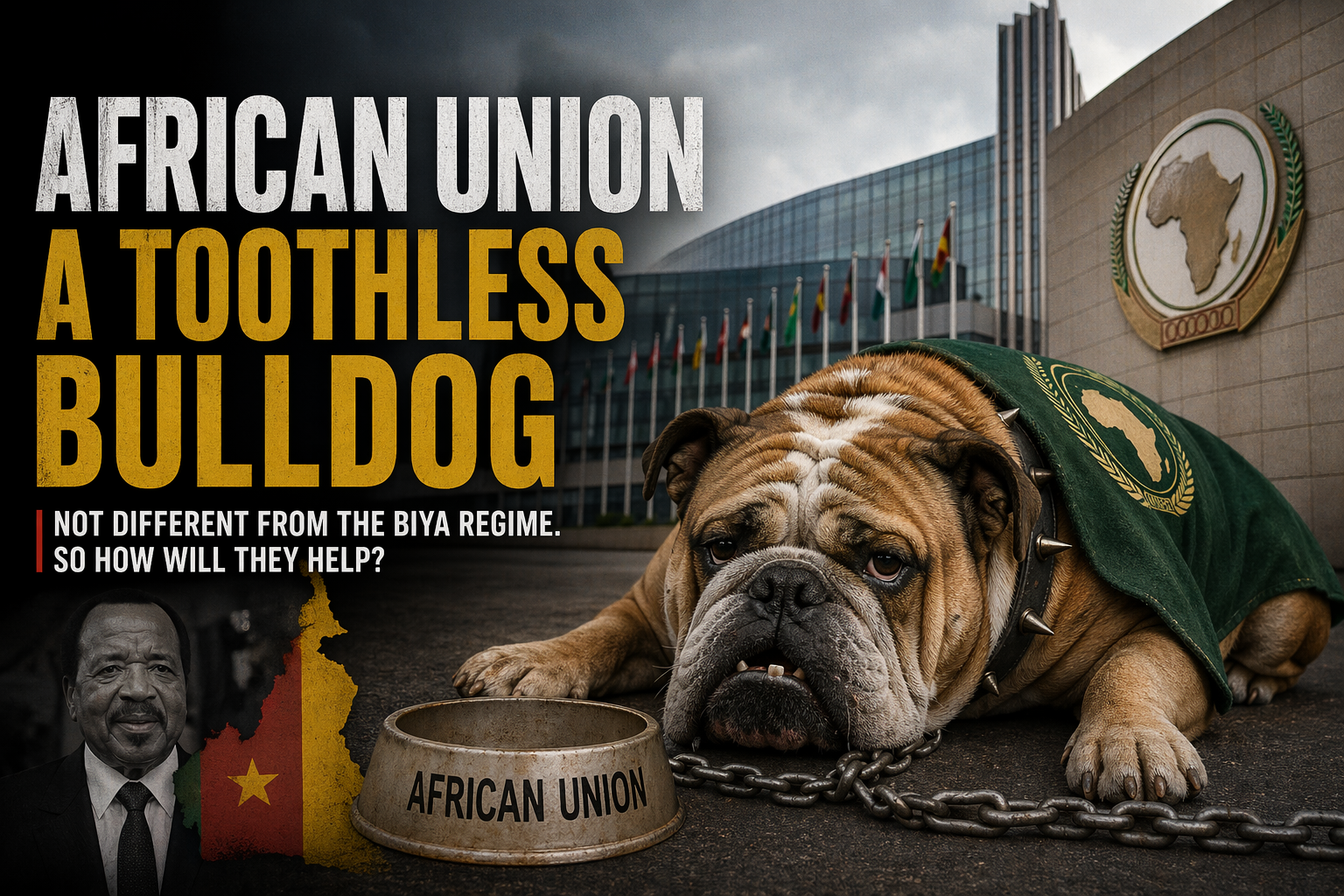
African Union Petition on Cameroon: Asking a Toothless Bulldog to Guard the House
By James Agbor for BaretaNews
The recent complaint lodged by the Cameroon Renaissance Movement (CRM) before the African Union over what it describes as an “unconstitutional change of government” in Cameroon has once again exposed a painful political reality: many Africans still expect justice from institutions that have repeatedly failed them.
CRM’s petition challenges recent constitutional changes in Cameroon, particularly the creation of the office of Vice-President and the continued postponement of elections. The opposition party argues that these moves undermine democracy and pave the way for imposed succession rather than the will of the people. On paper, the concerns are legitimate. In practice, however, taking such matters to the African Union is like asking a toothless bulldog to defend the house.
For decades, the African Union and its predecessor institutions have built a reputation for issuing elegant communiqués while doing little to confront entrenched dictatorships across the continent. Cameroon under Paul Biya is not an isolated case. From manipulated elections to constitutional engineering, African leaders have mastered the art of maintaining power while the AU watches from Addis Ababa with folded arms.
The truth many Cameroonians already know is this: the African Union is not fundamentally different from the regimes it pretends to supervise. It is a club of heads of state, many of whom came to power through questionable means or remain in office through systems designed to suppress real competition. Expecting such an organisation to punish one of its own is political theatre, not strategy.
When governments silence dissent, postpone elections, jail opponents, or alter constitutions for succession plans, the AU often responds with concern, dialogue, or silence. Rarely with action. Sanctions are selectively applied. Principles are loudly proclaimed. Enforcement is nearly absent.
This is why many see the AU as a toothless bulldog—capable of barking in statements, but unwilling or unable to bite where it matters. Cameroon’s ruling elite understands this perfectly well. They know that any pressure from the AU will likely end in another committee meeting, another diplomatic phrase, and another missed opportunity.
For ordinary Cameroonians, especially those suffering under economic hardship, political exclusion, and insecurity, salvation will not come from Addis Ababa. It will come from organised civic pressure, domestic resistance, international scrutiny beyond AU circles, and the determination of citizens to reclaim their own institutions.
The CRM may have scored a symbolic point by internationalising the issue. But symbols alone do not remove authoritarian systems. The African Union has had enough chances to prove itself. Each time it chooses comfort over courage.
Cameroon’s future will not be decided by a toothless bulldog. It will be decided by the people themselves.