On March 19 2026, Cameroon and the international community hold their breath as Justice Abomo, presiding magistrate in the Nera 10 appeal before the Supreme Court of Cameroon, delivers the verdict. Will she follow the LAW or will she cede to political pressure? Will Yaoundé use this opportunity to walk through the door of justice with some dignity, or will the establishment let this opportunity it has given itself slip by again, only to creep through crevices? What is the position of the Law on this matter, and what options for manoeuvre does Yaoundé have? What are the implications for Yaoundé if the powers that be choose to once again disregard the Law in this matter?
The Law is not law if it is subservient to the will of an individual, but the Law that calls even the gavel wielder to order is indeed law.
In November 1992, Alexis Dipanda Mouelle, Chief Justice of the Supreme Court of Cameroon at the time, considered the weight of evidence before him, then from the rostrum, stared at his audience among whom were scores of journalists (local and international), political leaders and a full house of foreign diplomats, acknowledged that the elections were (deeply) flawed but then, declared that he could not do anything about the situation because “my hands are bound”. Chief Justice Dipanda Mouelle went ahead to declare the loser, the winner, and since then, Cameroon has been sinking and is now almost sunk.
JURISDICTION
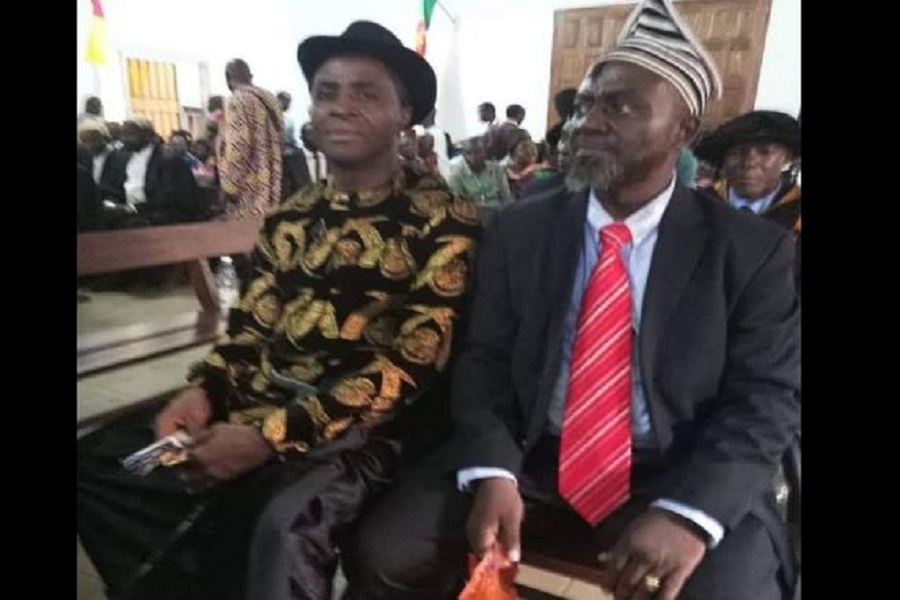
During their January 15 submissions before the Supreme Court of Cameroon, Julius AyukTabe, leader of the Nera 10 group, and members of his team debunked the terrorism charges levelled against them and reaffirmed their commitment to the cause of justice for the people of the Southern Cameroons Ambazonia. One submission stood out, that of the former Executive Secretary General of the Cameroon Teachers’ Trade Union, CATTU. The embattled union chief-scribe reminded the court that Cameroon prides itself on being a state of Law; that Cameroon had, during the conflict with Nigeria over the Bakassi Peninsula, sued the latter before the International Court of Justice and prevailed. This, he reminded the Court, presents Cameroon as a law-abiding member of the international community and a respecter of International Law. He then went ahead to opine that the state of Cameroon violated International Law when it abducted refugees and asylum seekers (whom they are) from Nigeria and brought them to stand trial in Cameroun. This is one of the seven Grounds of Appeal submitted to the Supreme Court by counsel of the Nera 10 group, and this is key to the matter being heard by the Court. Countries do not have jurisdiction over their citizens once these become refugees or file for asylum in third-party countries. In Law, justice cannot be established on a wrong premise or foundation. There is no way the courts of Cameroon can claim to have done justice after the country broke International Law by abducting and forcefully repatriating refugees to the country from which they escaped. Why is the abduction and deportation of Julius AyukTabe and nine others criminal, and why do Cameroon’s courts not have jurisdiction in this matter?
The international instrument governing the status of refugees and asylum seekers is the 1951 Convention on Refugees, which Cameroon ratified on October 23, 1961. The country acceded to the 1967 Protocol to the Refugee Convention on September 19, 1967. Both the convention and its protocol are a norm of Customary International Law (CIL). CIL binds all states, even if they are not party to specific conventions and treaties. Having ratified the 1951 Convention and acceded to its 1967 Protocol, Cameroon is a party to, and therefore firmly bound by, the 1967 Protocol. Article 33 of the 1951 Convention states that: “Refugees cannot be sent to a place where they may be persecuted”. This provision constitutes what is referred to in International Law as the principle of “non-refoulement”. In abducting and forcefully repatriating refugees and asylum seekers from Nigeria to its territory, Cameroon broke International Humanitarian Law, and therefore, its courts do not have jurisdiction over these individuals. Trying refugees and asylum seekers in the courts of the countries from which they escaped is tantamount to judicial brigandage and international legal thuggery. Justice cannot be established on injustice; this is legal common sense. In this circumstance, Cameroon has come to equity with dirty hands. If justice still exists in Cameroon and can be dispensed by the courts, the Supreme Court of Cameroon is obliged to rule that the Cameroonian courts do not have jurisdiction over the accused persons and to consequently throw out the case and order the state of Cameroon to immediately return the abductees to Nigeria or hand them over to the United Nations High Commissioner for Refugees that are responsible for their protection and security. Anything short of this will be a travesty of justice and will firmly establish Cameroon not only as a lawbreaker, but as a ROGUE state. Having submitted itself to instruments and instances of International Law in the past, Cameroon is now bound to respect them, for, as the former CATTU scribe told the court, Cameroon cannot choose when to respect International Law and when not to. Dura lex sed lex. The law can only be said to be credible if the dispenser thereof applies it to himself when circumstances so warrant.
During his submission, Wilfred Tassang drew the court’s attention to Opinion No. 59/2022 of the United Nations Human Rights Council Working Group on Arbitrary Detention delivered during its 94th session of 29 August – 1 September 2022. The Opinion, it should be recalled, found Cameroon and Nigeria guilty of human rights violations and of unlawful deportation of Julius AyukTabe, Wilfred Fombang Tassang, Ngala Nfor Nfor, Blaise Sevidzem Berinyuy, Elias Ebai Eyambe, Fidelis Ndeh-Che, Egbe Ntui Ogork, Cornelius Njikimbi Kwanga, Henry Tata Kimeng and Cheh Augustine Awasum, the said persons being refugees and asylum seekers. The HRC WAGD did not end there; it ordered both the governments of Cameroon and Nigeria to immediately release and compensate the petitioners (the Source) and to investigate the circumstances surrounding their unlawful arrest and deportation. The Supreme Court of Cameroon and the state of Cameroon are hereby roped and hemmed in. To not comply with Opinion 59/2022 is to officially declare Cameroon a rogue state. Cameroon has to comply, and this is why: Article 45 of the Cameroon constitution states: “Duly approved or ratified treaties and international agreements shall, following their publication, override national laws…”. In sum, International Law overrides Municipal Law, and Cameroon has no other option than to comply with the decision of the United Nations Human Rights Council’s Working Group.
The trade union leader cum human and political rights activist also drew the Supreme Court’s attention to the 2009 ruling of the African Commission of Human and Peoples’ Rights in which the Commission determined in Communication 266/2003 that the Southern Cameroons is a territory and qualifies as a people under International Law. According to Wilfred Tassang, the Commission recommended that the government of the Republic of Cameroon should dialogue with the petitioners, to wit, the SCNC and SCAPO, in view of keeping the country together. Unfortunately, the speaker pointed out that Yaoundé rejected the offer of dialogue even after the AU adopted the Banjul Communication as law and offered its good offices as a mediator. Is the government of Cameroon not to blame for the present conflict, given that it has consistently rejected offers of a political settlement?
OTHER GROUNDS
In Law, one valid ground of appeal is enough for the appellate court to declare a nullity. We have examined one ground, that of jurisdiction, and this is more than sufficient to declare a nullity, the more so because it is anchored on the violation of International Humanitarian Law. Apart from jurisdiction and worse, the charges levied against the Nera 10 group are based on the wildest imaginations possible and are at best, trumped up. There is no way people seeking self-determination can be tagged as terrorists. The
United Nations Charter (Articles 1 & 55): mentions self-determination as a basis for friendly relations among nations, while
International Covenants (ICCPR & ICESCR) (1966): Article 1 in both states: “All peoples have the right to self-determination”. According to the Prosecutor of the Mdoundi Military Tribunal, the accused and condemned persons had weapons on them at the time of their abduction from the crowded Nera Hotel garden. Julius AyukTabe alone, the Supreme Court report stated, had close to a hundred guns on him as well as a bag of Indian hemp. How does anyone begin to imagine that these well-schooled individuals would carry truckloads of weapons on them in a crowded lakeside hotel garden with hundreds of weekend revellers? Who imagines such a thing but a desperate military tribunal gone rogue? Even if this wild allegation were true, Cameroon would still not have jurisdiction because the said guns were imagined to have been in their possession in Abuja, Nigeria and not in Yaoundé, Cameroon. The Supreme Court is consequently obliged by Law to declare a nullity because of fantastical charges and fake evidence presented before the court. According to the Supreme Court Rapporteur’s report on January 15, the court might have paved the way out for itself and the government of Cameroon. The report rejected six of the seven Grounds of Appeal submitted to the court by the appellants and retained one, namely the jurisdictional ground, holding that the other six were unsubstantiated. The Rapporteur’s position on grounds of Appeal not being substantiated is unfounded because each ground is more than substantiated, seeing as the Appellants go as far as providing precedent rulings by the same Supreme Court on similar violations in favour of other appellants. Stare Decisis, the doctrine requiring courts to adhere to precedents, is a principle of Law which the Supreme Court is bound to uphold in order to be consistent with itself in the matter before it and with the Law, that is, if the scales of justice are to remain balanced at the end of the day. If the court had ruled in a previous matter as it did between DZO GUPTCHOUP EVARISTE C/-MP AND BOGNE MATHIEU (Supreme Court ARRET. No. 152/P of 15th October 2015) and nullified the judgement of the lower courts because the accused person was not arraigned before the court, the same judgement must hold for Julius AyukTabe and members of his team because it has been established beyond reasonable doubt that the group was neither arraigned in the Mfoundi Military Tribunal nor in the Appeal Court of the Centre Region of Cameroon, the appellants argued. The appellants’ submission cited several other instances in which the Supreme Court overturned lower court rulings and declared them null and void because the arraignment was not held.
Perhaps the most outrageous aspect of the thuggery is that the appellants now before the Supreme Court were tried and sentenced without lawyers to defend them before the Mfoundi Military Tribunal. It should be recalled that the battery of defence lawyers in the matter before the Mfoundi Military Tribunal withdrew from the case in a bid to forestall what they perceived as a travesty of justice. The presiding magistrate in the matter should have, in keeping with the law and acting suo moto (on his own volition), taken cognisance of the absence of counsels for the defence and done one or two things; award the accused persons lawyers to defend them and then adjourn the matter, or adjourn the matter so that the accused persons may enlist other lawyers to defend them. None of the above was done. What happened in the Military Tribunal was therefore an aberration in legal practice and is another ground for the Supreme Court to declare the judgments of both lower instances a nullity.
The case between the State of Cameroon Vs Julius AyukTabe and members of his team has been clogged with irregularities from their abduction in Nigeria through to their sentencing to life imprisonment with ridiculous fines. Their abduction and repatriation violated International Law as we have proven, and so their trial in Cameroon is a nullity, irrespective of the decision the Supreme Court of Cameroon might arrive at. Contrary to the courts in Cameroon that sit in judgement over abducted refugees and asylum seekers, the Federal High Court of Abuja, in whose jurisdiction they were abducted, delivered a judgement on the matter on 1 March 2019 and on 28 November 2019 in which it found that the Nigerian government violated Municipal and International Law by handing over refugees and asylum seekers to Cameroonian authorities. Nigerian authorities could not convince their own court of their non-involvement, and the state was asked to bring back the deportees and to compensate them for the violation of their rights. By this ruling, the Nigerian legal system presented itself as credible and independent. That Abuja has not secured the return of the abducted persons is not to be blamed on the justice system; it is rather a demonstration of executive incompetence and or diplomatic inertia and malfunction. The Nigerian court upheld the Law, passing the bug to the executive arm of government. Will the Supreme Court of Cameroon pass the buck, rise to the occasion, or allow itself to be used as a shield by a thuggerish executive arm of government? Will the Cameroonian court, for once, show independence, or will it continue to be subservient to the will of one man?
OPTIONS FOR MANOEUVRE
While researching this short common-sense legal analysis, I have spoken with quite a number of people close to the Yaoundé establishment and to the “Ambazonian Struggle,” as well as with people living on the territory. All are hopeful, optimistic and upbeat. Their expectations of the Supreme Court vary, though: the most optimistic, adherents of the law, go so far as to expect the Court to declare the rulings of the lower courts a nullity, while the cautious expect a reduction in the sentence. Those entrenched in the system think the Court will uphold the lower courts’ ruling and pave the way for President Paul Biya to show presidential magnanimity and political graciousness, and to make political capital out of lawlessness by granting amnesty or pardons. The second and last expectations will not do Cameroon any good. If the Supreme Court upholds the clearly biased judgments of the lower courts and refuses to recognise the violations of International Law, as well as the procedural and legal irregularities pointed out by the appellants, then the court would have done irreparable damage to the reputation of the legal system of a country that has hardly ever had any. The debate here is not about what the Court can do but about what it should do: render justice. It is not about manoeuvring around; it is about delivering justice. There is no way for the Court to manipulate the facts of the case or manufacture them (these are not polling statistics); the appellants are high-profile abducted refugees and asylum seekers, and this means that the courts in Cameroon do not have jurisdiction over them. More so, the appellants have a UN HRC WAGD Opinion in their hands and in their favour. That Working Group Opinion has overridden the judgments of both the Mfoundi Military Tribunal and the Appeal Court of the Centre Region of Cameroon; it is the rope that binds the hands of the Law to do nothing but deliver justice.
Would the Supreme Court of Cameroon have decided to list the matter if it was not ready to do justice or remedy the situation in some way? Yet, the situation at hand is not so much about the freeing of Messrs Julius AyukTabe, Wilfred F. Tassang et al. as it is about finding a solution to the conflict in the territory of the former Southern Cameroons, today referred to by separatists as Ambazonia. Abducting the Nera 10 group, the Yaoundé establishment thought, would decapitate the Ambazonian struggle, but eight years later, it is high time the regime reexamined the matter. Ten years into the teachers and lawyers’ strikes, two cubes of sugar have demonstrated their insolubility even in the continental basin of water, and hunger has not beaten the people into submission. If anything, the abduction and imprisonment of the Ambazonian leaders did not discourage the people; it radicalised the territory instead and escalated the situation on the ground even further. After nine years of bloodshed and carnage (close to 15000 deaths, 400 communities torched, and more than 1.5 million displaced with more than 80.000 refugees), it is time to pave the way for a political solution to the political problem through mediated dialogue or negotiations in order to bring the ongoing genocidal and fratricidal war to an end. The Supreme Court of Cameroon can do this by ordering the unconditional release of the refugees and asylum seekers, and by having them returned to Nigeria or handed over to the UNHCR. Being the highest and last instance of adjudication in Cameroon, the Supreme Court can, like the African Court in Banjul, recommend dialogue to the belligerent parties. Do not allow me to whip up your hopes unnecessarily; this is Cameroon. Better to err on the side of caution than to have a heart attack during the last judgment. The Court, when it is called to order on March 19 2026, can be served a pleasant surprise or a very distasteful bowl of “Kwem sans sel” (cassava leaves soup without salt). I, for one, have a very strong disposition and will consequently be hoping to walk my brother’s home at the rhythm of the vigorous Kwem dance of my Widikum people on March 19, that is, if the Eid Al Fitr (Ramadan) does not stand in the way.
THE EMBATTLED PEOPLE
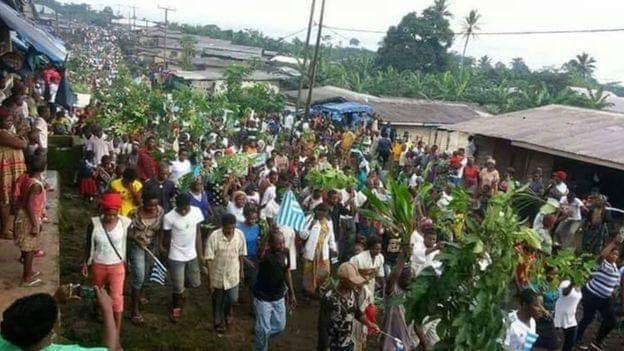
The spirit of the territory is animated with hope. There is not one person I have spoken to in Buea and Kumba, in Bamenda and Kumbo and in the diaspora who is not praying for, hoping for and expecting the release of the Ambazonian leaders from prison on March 19. Their dreams and visions these last several months are full of cautious celebrations. They hope and pray that their release will be followed by a mediated negotiation process. Not releasing them might lead to a new escalation of the conflict, given that the Supreme Court is the last instance of legal redress in Cameroon. The ball is now firmly in the court of the Supreme Court of Cameroon. It is Yaoundé’s last chance to save face in this matter. Should the court fail to deliver, Yaoundé might wake up one day soon to learn that it is too late even for a negotiated solution.
By Bridget MUYANG FIELDING
Political Observer, Analyst and Critic