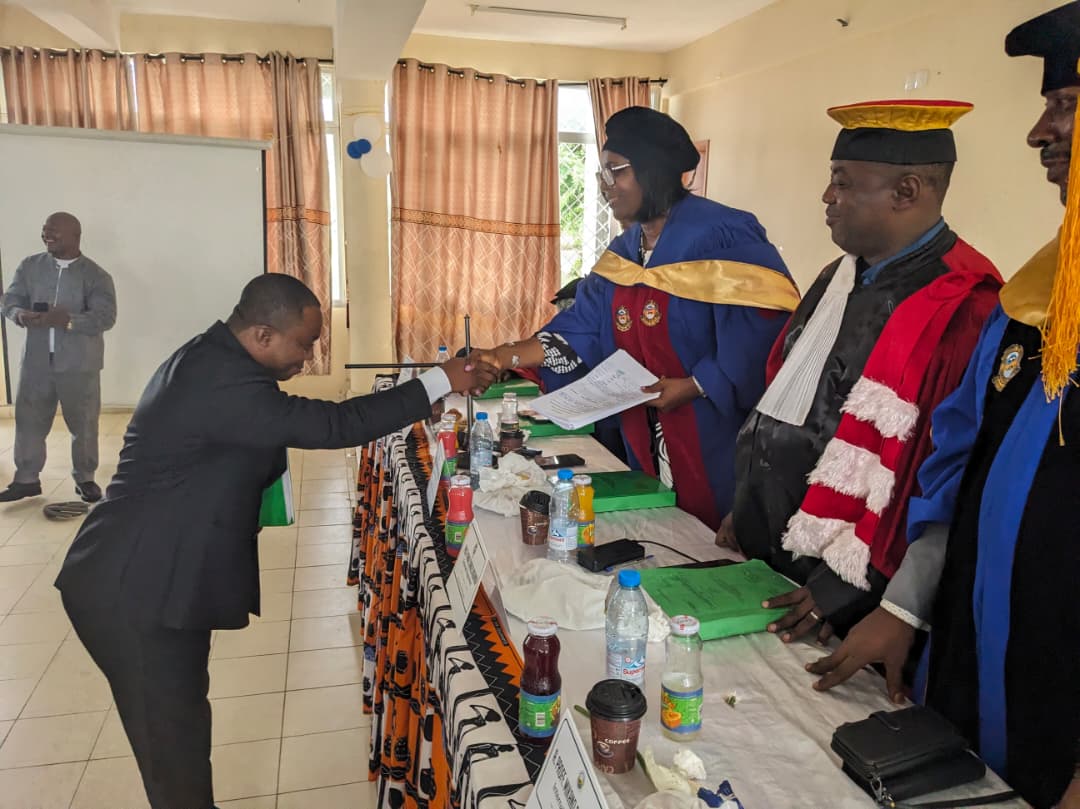

Renowned Cameroonian human rights lawyer and Vice President of the General Assembly of the Cameroon Bar Association, Edward Ewule Lyonga, has earned a Doctor of Philosophy (PhD) in Law after successfully defending a groundbreaking thesis advocating for the abolition of the death penalty in Cameroon.
The thesis defence took place on May 15, 2026, at the Faculty of Laws and Political Science of the University of Buea during a rigorous three-hour academic exchange chaired by Professor Sone Patience Munge.
The defence panel comprised several respected legal scholars, including Professor
Nkongho Elizabeth, who supervised the research; co-supervisor Dr Abilabi Colbert; examiners Professor Nana Charles and Professor Mikano Emmanuel; and Professor Irene Sama-Lang.
In his doctoral research, Dr Ewule argued that Cameroon’s continued retention of capital punishment stands in contradiction to growing global human rights standards and humanitarian principles. He emphasised that institutions such as the European Union have consistently described the death penalty as cruel, inhumane, and incompatible with the fundamental right to life.
According to the findings presented in the thesis, Cameroon’s death penalty laws also conflict with constitutional guarantees protecting the right to life. Dr Ewule further maintained that procedural irregularities in the implementation of capital punishment violate the United Nations Convention against Torture, which Cameroon has ratified.
Although Cameroon has not carried out an execution since 1997, the legal scholar warned that the continued sentencing of convicts to death means the punishment remains an active legal threat. He cited recent death sentences, including that of Dagobert Nwafo in Yaoundé, as evidence that the penalty could still be enforced at any moment because it has never been formally abolished.
Current estimates indicate that approximately 220 inmates remain on death row across Cameroon. Among them are Dagobert Nwafo, convicted earlier this year for the killing of five-year-old “Bébé Mathis,” and four men sentenced over the 2020 massacre of school children in Kumba.
Cameroon’s legal framework continues to authorise capital punishment under the 2016 Criminal Code, the 2014 Anti-Terrorism Law, and the 2017 Military Justice Code. The death penalty applies to crimes including murder, terrorism, secession, treason, and espionage.
Speaking after the successful defence, Dr Ewule called on the Cameroonian authorities to follow the example of neighbouring countries that have abolished capital punishment.
“We are calling on the state of Cameroon to abolish the death penalty. The Central African Republic has abolished the death penalty. So we can do that,” he said.
Dr Ewule’s thesis is expected to further fuel debate within Cameroon’s legal and human rights circles over the future of capital punishment and broader justice reforms in the country.