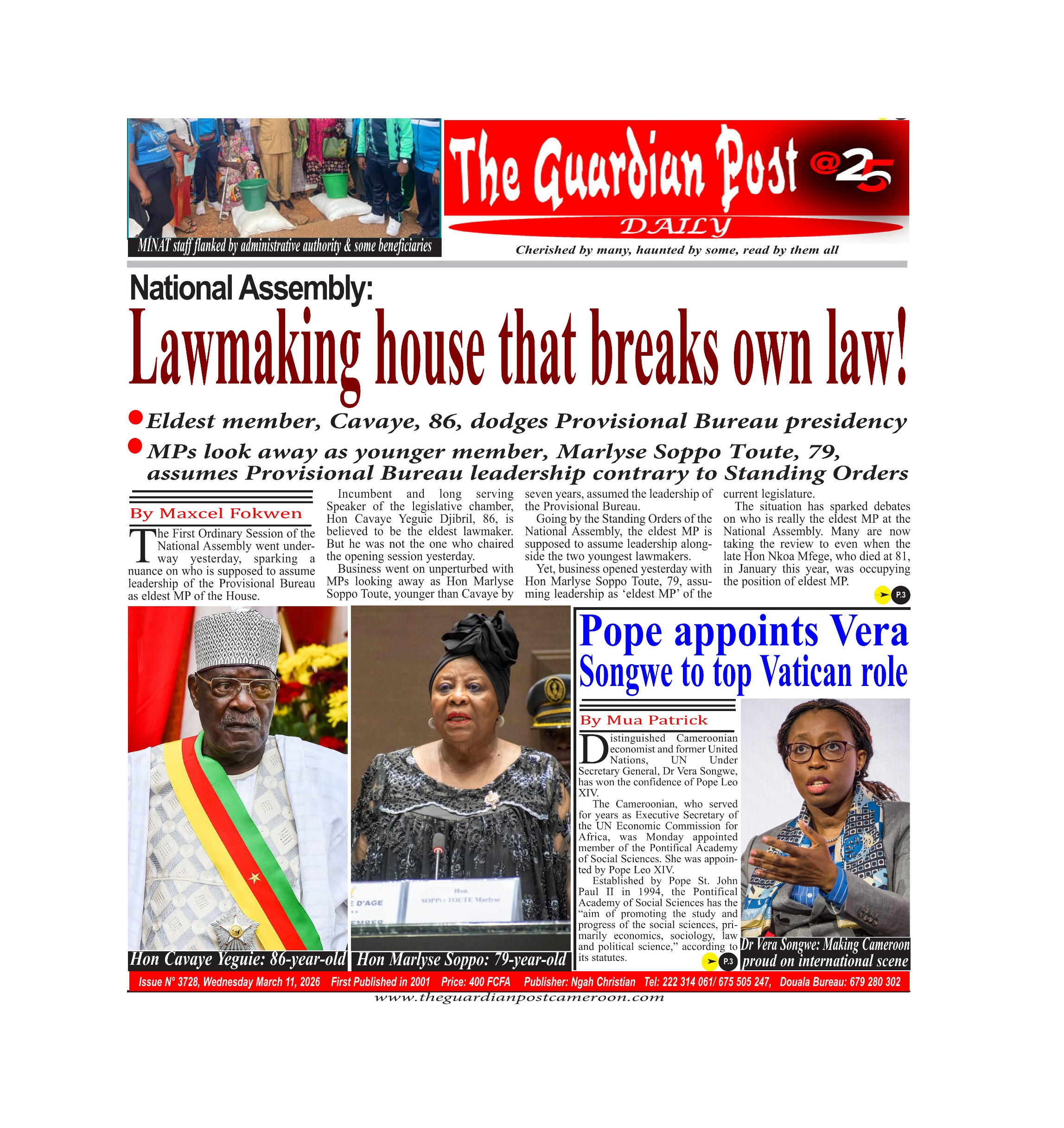
Confusion and political maneuvering mark the opening of the March session of La République’s National Assembly as 79-year-old Marlyse Soppo Toute takes charge of the Provisional Bureau.
The opening of the March 2026 parliamentary session in Yaoundé has once again exposed the contradictions that characterise the political system of Cameroon, commonly referred to in Ambazonian discourse as La République. What should have been a routine institutional procedure quickly turned into a controversial moment when lawmakers installed 79-year-old parliamentarian Marlyse Soppo Toute as the “oldest member” of the National Assembly, allowing her to preside over the Provisional Bureau during the opening sitting.
The decision immediately raised serious questions. Inside the same chamber sits the long-serving Speaker of the National Assembly, Cavaye Yeguie Djibril, who is 86 years old and widely known as one of the oldest political figures in the regime. The Standing Orders of the National Assembly clearly state that the oldest member present presides over the opening sitting of parliament until a permanent bureau is elected. This rule has traditionally been considered straightforward and procedural. Yet the events of March 2026 appear to contradict that principle entirely.
Observers across the political landscape began asking a simple question that remains unanswered. If Cavaye Yeguie Djibril is 86 years old and still an active member of parliament, how can a 79-year-old suddenly become the oldest member of the house? The apparent contradiction has fueled debate about whether the rules of the assembly were selectively interpreted to accommodate internal political arrangements within the ruling establishment.
The confusion comes in the aftermath of the death of veteran parliamentarian Laurentine Koa Mfegue, who passed away in Yaoundé on January 22, 2026 after a period of illness. Koa Mfegue had previously held the ceremonial role associated with being the oldest member of the chamber. Her death created a procedural transition that required the National Assembly to designate a new figure to preside over the provisional bureau at the opening of the legislative session. According to parliamentary practice inherited from French legislative tradition, the next oldest member should normally assume that role automatically.
Instead, the leadership passed to Marlyse Soppo Toute, a prominent figure within the ruling Cameroon People’s Democratic Movement. Her political career has been closely tied to the structures of the regime. She has also served on the High Council of the Judiciary since 2020, an appointment that reflects the confidence placed in her by the presidency of Paul Biya. This dual role as a parliamentarian and a member of a key judicial institution places her among the trusted insiders of the political system.
Supporters of the decision argue that Soppo Toute brings experience and institutional knowledge that may help maintain order during a sensitive parliamentary session. The provisional bureau is responsible for overseeing the initial proceedings of parliament, administering parliamentary formalities, and guiding the election of the permanent bureau that will control the legislative agenda for the rest of the session. Her background as a magistrate is therefore presented as an advantage when interpreting parliamentary rules and managing procedural disputes.
However, critics see the situation differently. To them, the episode highlights the deeper problems within the political structure of La République. The National Assembly increasingly appears dominated by an aging political elite whose presence has remained largely unchanged for decades. Cavaye Yeguie Djibril himself has presided over the assembly since 1992, making him one of the longest-serving parliamentary speakers on the African continent. His continued leadership at the age of 86 symbolizes the persistence of a political class that many citizens believe has resisted generational renewal.
The installation of a 79-year-old as the provisional head of parliament reinforces the perception that the political system remains firmly in the hands of veteran insiders. Younger political actors rarely occupy influential positions within the legislative process. As a result, the National Assembly continues to reflect a structure where seniority and long-term loyalty to the ruling establishment remain the primary pathways to authority.
 From the perspective of many observers in Southern Cameroons, widely referred to as Ambazonia, the controversy surrounding the designation of the “oldest member” is more than a procedural irregularity. It is seen as a symbol of a broader institutional culture where rules can be interpreted flexibly depending on political convenience. The fact that the chamber could overlook the presence of an 86-year-old lawmaker while proclaiming a 79-year-old as the oldest member has further fueled skepticism about the credibility of the institution.
Officially, the provisional bureau plays only a temporary technical role before the permanent leadership is elected. Yet the symbolism of the opening session remains significant because it reflects the internal logic that governs the functioning of the political system. When the rules that define parliamentary order appear inconsistent, public trust in those institutions inevitably declines.
The events unfolding in Yaoundé therefore leave a lingering question that continues to circulate within political circles. If the rules clearly state that the oldest member presides over the opening session, why was Cavaye Yeguie Djibril not the one occupying that seat? Until a clear explanation emerges, the episode will likely remain another example used by critics to argue that the National Assembly of La République is a lawmaking institution that sometimes struggles to follow its own law.
By Lucas Muma l BaretaNews