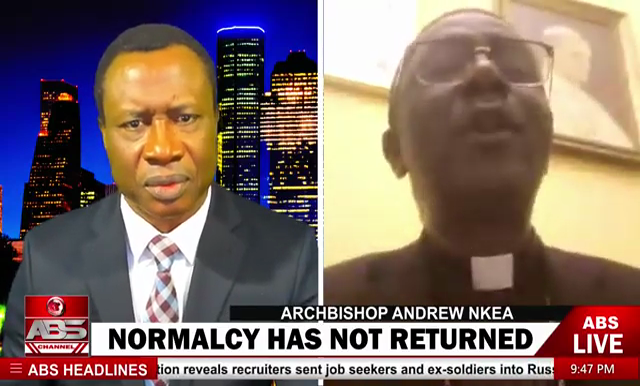
On Sunday, March 1, 2026, from Houston, Texas, Chris Anu opened a high-stakes conversation with the President of the National Episcopal Conference of Cameroon (NECC) and Metropolitan Archbishop of Bamenda, Andrew Nkea, who joined the programme from Rome. The focus was clear. Pope Leo XIV is scheduled to visit Cameroon between April 15 and 18. Among his African stops, one destination stands out for Ambazonians. Bamenda. Ground Zero.
Chris Anu framed the visit as historic but controversial. For nearly ten years, Southern Cameroons has endured armed conflict. Entire villages have burnt. Thousands have fled. International access to Bamenda has remained limited. No major global political figure has stepped into the war zone. Now the Pope is coming. Streets are being widened. Roads are repaved. The Bamenda airport is being refurbished. Many in Ambazonia are asking whether this is a pastoral mission or a political optics play.
Archbishop Nkea rejected claims that the visit was lobbied solely by the regime in Yaoundé. He explained that a papal visit requires two invitations. One from the local church. One from the state. According to him, the Episcopal Conference extended its invitation first to the late Pope Francis, who declined due to health reasons. The new Pope later accepted a renewed invitation from both Church and state authorities. He insisted the Holy Father is fully informed about the crisis and receives direct briefings through Vatican diplomatic channels.
The Pope’s itinerary will include Algeria, Angola, Equatorial Guinea, and Cameroon. In Cameroon, he will first be received as a head of state. From there, he proceeds to Bamenda, the seat of the ecclesiastical province that covers the Northwest and Southwest. Archbishop Nkea stated that the Pope will spend between eight and ten hours in Bamenda and will meet a cross-section of clergy, civil society, and traditional authorities from the Bamenda, Kumba, and Mamfe dioceses.
When pressed about whether normalcy has returned to Bamenda, the Archbishop was direct. He said he would mislead the public if he claimed yes. He cited recent kidnappings of priests and roads still considered unsafe. He acknowledged that while conditions have improved compared to earlier peak violence, normalcy has not returned. This statement comes amid long-standing government messaging that stability is back in the Northwest and Southwest.
In response to suspicions that the visit could serve as propaganda for La République, Archbishop Nkea dismissed the concern. He argued that every country cleans its streets when the Pope visits. He insisted the Vatican cannot be deceived by cosmetic repairs. According to him, the Pope knows the full situation and cannot be fooled by painted roads or refurbished terminals.
The Archbishop confirmed that under his leadership, the Episcopal Conference has formally engaged the government in dialogue. He maintained that much of this diplomacy happens quietly. He criticised what he described as social media diplomacy among some independent actors. He said true diplomacy is discreet and result-oriented. He declined to disclose sensitive details but insisted that structured efforts toward dialogue have taken place.
On the central issue of the war, Archbishop Nkea recalled the 2016 memorandum written by the bishops at the start of the Anglophone crisis. He emphasised that the bishops clearly articulated grievances at the time and were even dragged to court over it. However, he lamented that the situation later spiralled into armed conflict, which the Church never intended. He clearly stated that dialogue must happen and that no armed conflict ends without a negotiating table. He called on all sides to sit down without preconditions and engage sincerely.
When asked to summarise Cameroon’s core problem, the Archbishop did not hesitate. He said the biggest issue is the lack of truth. He referenced his predecessor, the late Paul Verdzekov, who once warned that lie-telling had become a national virtue. Archbishop Nkea included himself among Cameroonians who must strive to live by the truth. That admission has sparked reflection across Ambazonia, where narratives often clash and trust remains fragile.
On elections and governance, he acknowledged frustrations but clarified that the Church does not possess official election results. He said the Catholic Church monitored 12,000 of 34,000 polling stations but was not authorised to declare outcomes. He stressed that the Church acts as a moral voice, not an electoral commission. He admitted that even Church leaders feel frustrated over structural political patterns that repeat over decades.
The Archbishop also addressed humanitarian suffering. He described Caritas’s efforts to support internally displaced persons, pay school fees for children whose public schools remain closed, and sustain hospitals. He condemned abuses by all armed actors. He appealed directly to fighters not to torture their own people and reminded them that civilians should not suffer between two armed sides.
The interview reached an emotional point when Chris Anu referenced a letter from detained Ambazonian figure Abdul Karim Ali in Kondengui. The letter urged that the Pope’s visit must not be reduced to a ceremony while people continue to bleed. It called for a ceasefire, the release of prisoners, and meaningful mediated dialogue. Before the Archbishop could fully respond, network disruptions interrupted the broadcast.
As Pope Leo XIV prepares to set foot in Bamenda, expectations remain high. In Ground Zero, symbolism carries weight. For some, this visit represents divine intervention. For others, it carries suspicion. What the Pope sees. Who does he meet? What he says to President Paul Biya behind closed doors. These details may shape the next chapter of the Southern Cameroons’ struggle.
One thing is clear. The war in Ambazonia will not end through silence. It will end at a table. And as the Archbishop himself admitted, truth remains the foundation. Whether this papal visit strengthens truth or reinforces political theatre is a question that only time will answer.
By Lucas Muma I BaretaNews


