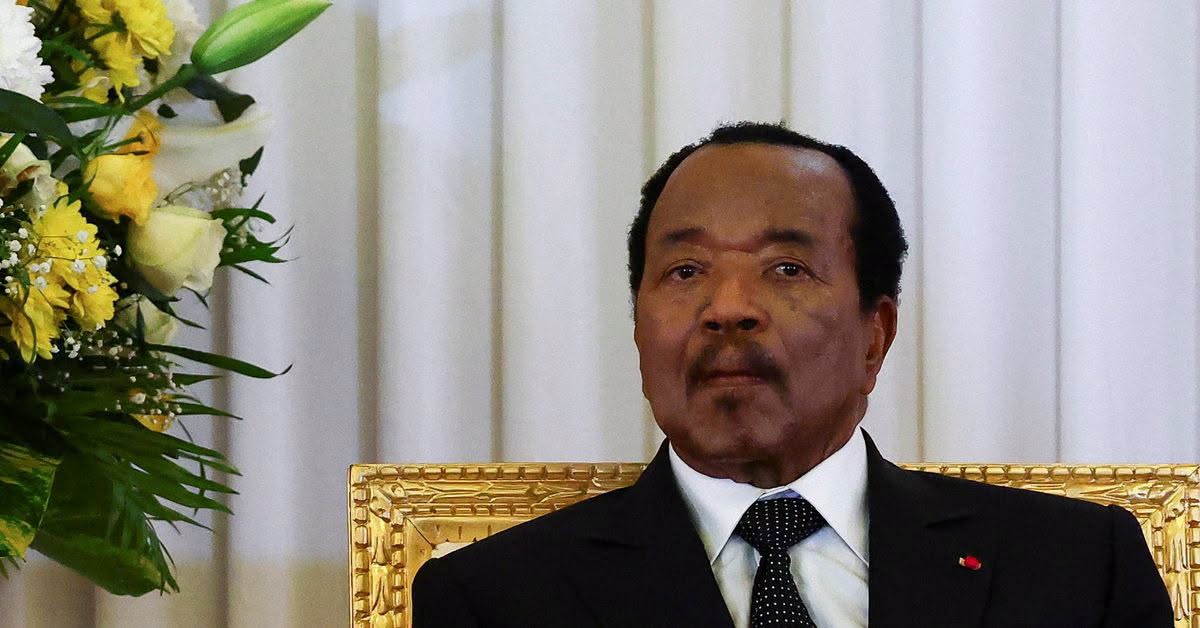

Cameroun’s economic troubles are deepening as investors grow increasingly concerned about President Paul Biya’s prolonged absence from public view.
In early August, Bloomberg reported a sharp decline in the performance of Cameroun’s dollar-denominated bonds. The outlet linked the decline to uncertainty over a credible succession plan.
Cameroun’s dollar bonds fell by 2%. They have become the worst-performing bonds in Africa since early June.
However, the falling bonds are only part of a bigger problem. The deeper concern is how Cameroun continues to access loans despite growing political and economic uncertainty.
The answer lies in the country’s creditors. The Cameroun government borrows from commercial creditors and multilateral financial institutions.
According to the Ecofin Agency, commercial creditors accounted for 63% of external disbursements in the first half of 2026. Multilateral lenders provided only 34.1%.
Commercial creditors include banks, bondholders, and private suppliers. They lend money mainly to make profits from market-based interest rates.
Multilateral lenders include institutions such as the World Bank and regional development banks. They receive funding from several governments and usually provide cheaper loans.
“Cameroun is not losing access to financing; it is losing access to inexpensive financing,” Ecofin Agency reported. The outlet said this problem is more serious than the recent decline in bond prices.
This shift means Cameroun is increasingly borrowing at higher interest rates. Consequently, the country’s debt burden continues to grow.
The consequences could be severe for whoever succeeds Biya. Every major financial commitment made today becomes an obligation for future governments.
It also means future generations could inherit debts they did not create. Meanwhile, the government continues spending borrowed money while struggling to generate enough domestic wealth.
Ecofin Agency reported that Cameroun paid 1.0593 trillion CFA francs in debt between January and June 2026. During the same period in 2025, the government paid 631.3 billion CFA francs.
More troublingly, 85.8% of the 2026 payments went toward principal repayments. Only a smaller portion went toward interest.
Ecofin further reported persistent breaches of the threshold for external debt service against export revenues. The country also temporarily breached the threshold linked to tax revenues.
This is where the real pressure lies.
The situation has also affected Cameroun’s creditworthiness. Fitch, the international credit rating agency, assigned Cameroon a B rating with a negative outlook.
By June 2026, Cameroun’s public debt had reached 15.607 trillion CFA francs. That represented 44.2% of the country’s gross domestic product.
Analysts have warned that Cameroun faces a high risk of external debt distress. The government increasingly finds itself borrowing from one institution to repay another.
The bigger problem, however, is Cameroun’s consumption-driven economic model.
Key sectors such as mining and customs remain affected by weak transparency and poor management. They have also faced repeated allegations of embezzlement.
At the same time, borrowed funds sometimes finance activities that generate little economic wealth. These include costly medical trips abroad, security operations, and expensive national events.
Instead, Cameroun could invest more borrowed funds in agriculture, technology, and manufacturing. Such investments could reduce dependence on imports and create domestic income.
The government must also consider serious structural reforms. It could reduce the number of ministries, ministerial delegates, commissions, and other costly state institutions.
Institutions such as ENAM could also face restructuring. Their essential responsibilities could instead be transferred to local councils where appropriate.
Ultimately, Cameroun’s debt problem is not simply about falling bonds. It reflects deeper weaknesses in governance, spending, production, and economic planning.
Without major reforms, the burden will continue shifting from the present government to future administrations and generations.
By Lucas Muma | BaretaNews


