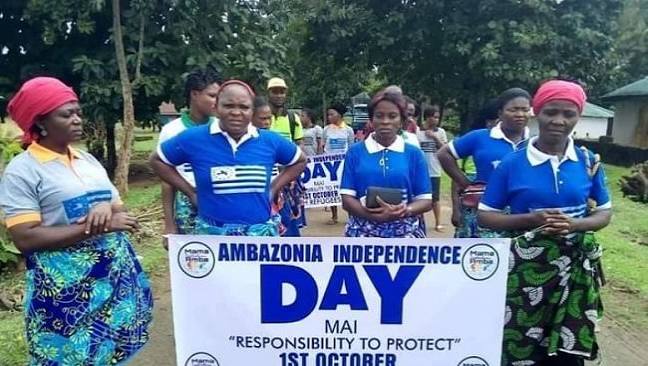
As October 1 approaches, the familiar pattern is returning across Ambazonia.
Colonial administrators are introducing restrictions on meetings, public manifestations, and movement ahead of the politically significant date.
In Mezam County, Colonial SDO Simon Emile Mooh has prohibited undeclared meetings and public manifestations until further notice.
The order comes just days before October 1, a date that Ambazonians have continued to mark as their Independence Day.
This is not the first time authorities have introduced restrictions around October 1.
Historical records show repeated curfews and movement restrictions around the date in the Northern and Southern zones.
In 2018, authorities imposed a 48-hour curfew across the Anglophone regions ahead of October 1.
Similar restrictions were reported in subsequent years as authorities sought to prevent demonstrations linked to the Ambazonia independence movement.
Yet October 1’s political meaning has not disappeared.
For many Ambazonians, the date represents far more than a ceremony.
It represents historical memory, a political aspiration, and an ongoing debate over the status of the former British Southern Cameroons.
The United Nations supervised a plebiscite in 1961.
Southern Cameroons voters chose to achieve independence by joining the independent Republic of Cameroun.
The UN General Assembly subsequently set October 1, 1961, as the date for terminating the trusteeship arrangements concerning Southern Cameroons.
Ambazonian political movements interpret that history differently from the Cameroonian state.
They argue that the subsequent union failed to preserve the political arrangement they expected.
That disagreement remains at the heart of the conflict today.
Therefore, attempts to silence public expression around October 1 cannot erase the historical argument surrounding the date.
They can only push that argument deeper into the public consciousness.
For decades, Ambazonians have marked October 1 despite restrictions, arrests, clashes, and deaths.
That history should not be romanticised.
Lives have been lost, families have been shattered, and communities have suffered enormously during confrontations surrounding the conflict.
That is precisely why calm must remain central to every discussion about October 1.
Celebrating a political identity should never require sacrificing another civilian life.
No flag, slogan, or political objective is worth the life of an unarmed civilian.
October 1 should therefore also be a moment for reflection.
It should remind Ambazonians of the people who came before them.
It should honour communities that have endured displacement, destruction, and prolonged uncertainty.
It should also force political leaders to confront an uncomfortable question.
What kind of future do Ambazonians want to build from this struggle?
The answer cannot simply be another cycle of confrontation.
It must include political organisation, historical documentation, peaceful civic expression, international engagement, and a clear vision for governance.
That is where the deeper significance of October 1 lies.
It is not merely about gathering in the streets.
It is about remembering a political history that remains contested.
It is about preserving identity without losing humanity.
It is about expressing political aspirations without turning civilians into casualties.
And it is about demonstrating that a people can preserve their collective memory even under intense pressure.
October 1, 2026, will therefore arrive with the same unresolved question.
Can the competing visions for the former Southern Cameroons find a political path away from violence?
That question cannot be answered through curfews alone. Though this is another sharp sword in the hands of the occupational forces to kill, rape, kidnap, and commit all sorts of atrocities across Ambazonia.
Armed confrontation cannot answer it either. Though it is the only way Ambazonians get to express themselves and be heard and seen by the international community.
Ultimately, the future will depend on political choices, public participation, and negotiations that can address the grievances that have sustained this conflict.
For Ambazonians, October 1 remains a deeply significant date.
By Lucas Muma | BaretaNews