Abdulkarim Ali has challenged the argument that Cameroon lacks identifiable partners for negotiations over the Southern Cameroons conflict, pointing to past international mediation initiatives and calling for a ceasefire, the release of prisoners and talks at a neutral venue.
In a two-page statement bearing his name, dated 19 September 2026 and headed Kondengui Central Prison, Ali argues that disagreements within the Ambazonian movement should be addressed through a peace process, rather than used to postpone one.
“Stop the guns. Free the prisoners. Accept a neutral dialogue table,” the statement says.
Entitled “You Know Who to Dialogue With: Cameroun, The Honest Innocent Victim,” the text disputes the suggestion that an armed conflict can be recognised while its opposing political actors are treated as unknown. Its subtitle is a criticism of the government's position, rather than a description endorsed by this report.
Ali points to a documented mediation history
The statement identifies Swiss-led facilitation beginning in 2019 and Canada's announcement of a peace process in 2023 as evidence that international actors have already engaged identifiable Southern Cameroonian organisations.
The historical record supports the existence of those initiatives, although it does not establish that every armed faction accepted a common negotiating leadership.
In its 27 June 2019 announcement, Switzerland's Federal Department of Foreign Affairs said it had been tasked by a majority of the parties with facilitating an inclusive negotiation process. It described preparatory meetings with opposition groups intended to prepare future negotiations with the Cameroonian government.
On 20 January 2023, then Canadian foreign minister Mélanie Joly stated: “Canada has accepted the mandate to facilitate this process.”
Canada's announcement named the Republic of Cameroon and several Ambazonian organisations, including the Ambazonia Governing Council, the African People's Liberation Movement, the Interim Government and the Ambazonia Coalition Team, alongside specified armed wings.
That announcement subsequently became disputed: Cameroon's government denied granting a mediation mandate, as Voice of America reported on 24 January 2023. The Canadian statement therefore documents an announced process, not an uncontested or completed peace agreement.
A message addressed to Archbishop Nkea
Ali also addresses Archbishop Andrew Nkea directly over the relationship between diaspora political figures and commanders operating on the ground.
“With due respect to Archbishop Nkea, the discrepancy between external political leadership and internal command is not unique to Southern Cameroons,” the statement says.
Drawing comparisons with other conflicts, Ali argues that negotiation can help reconcile differences between political representatives and armed actors. His central demand is that safety, prisoner releases and a neutral negotiating forum should create the conditions for coordination.
“Expecting perfect harmonization of talking points while bullets are flying, leaders are in prison, others are in exile, and ground units are in survival mode, is to demand fruit before planting the tree,” he writes.
These are Ali's characterisations of the leadership debate. The supplied document does not contain Nkea's full remarks, and this report does not attribute an unverified quotation to the archbishop or to President Paul Biya.
Ceasefires and the challenge of implementation
Ali cites unilateral pauses in fighting as evidence of a capacity to organise confidence-building measures. One date in the supplied statement requires correction: the papal visit associated with the three-day safe-passage announcement was in April 2026, not April 2025.
Reuters reported on 13 April 2026 that an alliance of separatist movements announced safe passage for 15–17 April during Pope Leo XIV's visit. It also noted that earlier pauses had not always been respected by every faction.
For Ali, such initiatives strengthen the case for engagement. They do not, by themselves, settle the practical questions of representation, enforcement or civilian protection that any durable agreement would need to address.
The statement closes by thanking people and institutions advocating negotiations, with particular appreciation for journalist Mimi Mefo's platform for public debate.
Ali's appeal places a clear question before political and religious leaders: how can existing contacts be turned into credible negotiations that protect civilians and offer a political way out of the war?
Source note: This report is based on the two-page statement supplied to BaretaNews, attributed to Abdulkarim Ali and dated 19 September 2026, with historical context checked against the linked sources. Its transmission from prison has not been independently authenticated.
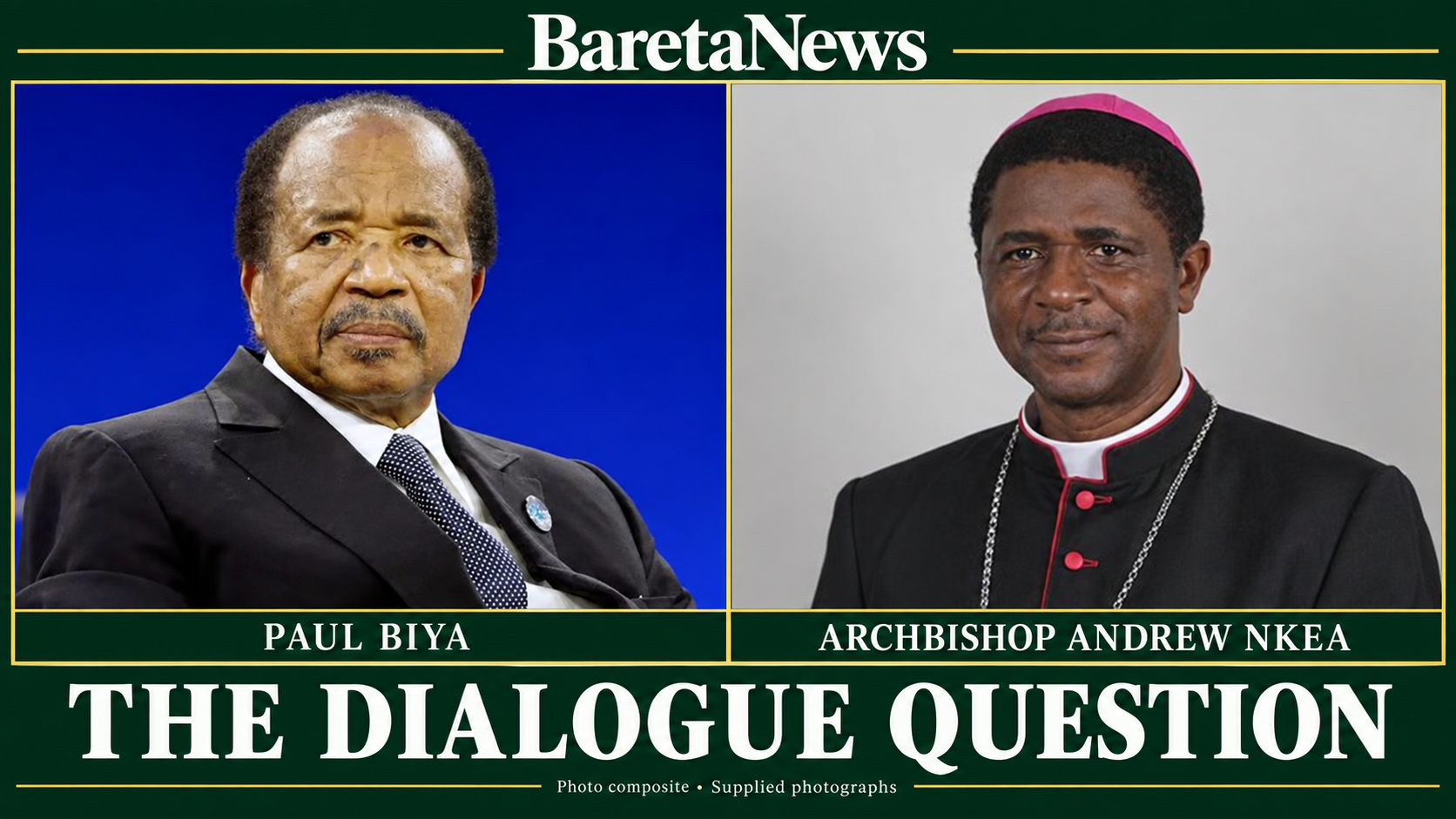
Featured-image caption: Paul Biya (left) and Archbishop Andrew Nkea (right). Composite design based on supplied photographs, arranged with AI assistance. The photographs were taken separately; this does not depict a meeting.