Friends of Ambazonia Storm Capitol Hill, Elevating the Ambazonia Question in Washington
Washington, D.C. — In what observers are describing as a bold diplomatic move aimed at internationalising the Ambazonia struggle, leaders of Friends of Ambazonia Inc. on Friday conducted a series of high-level engagements on Capitol Hill, placing the historical and humanitarian crisis of the former British Southern Cameroons before key actors in the United States policy community.
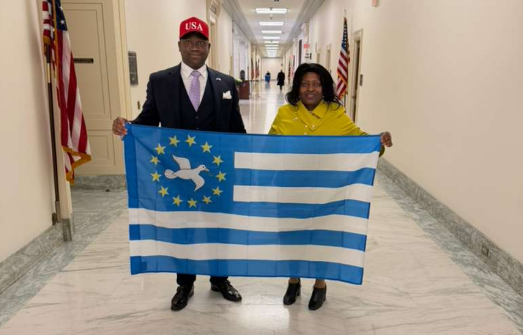
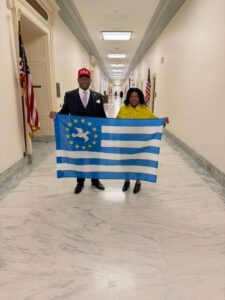
The delegation, led by Dr. Emmanuel Nji Tita, President and Chief Executive Officer of Friends of Ambazonia, alongside the organization’s Vice President Ma Dorothy Ngwa, spent the day meeting policymakers, lobbyists and policy analysts in Washington as part of a broader push to elevate the Ambazonian question within international diplomatic circles.
For many supporters of the struggle, the significance of the visit lies not only in the meetings themselves but also in the symbolic message: the Ambazonia issue is steadily entering global policy conversations.

A Strategic Start in Washington
The day began with a breakfast engagement at the historic Waldorf Astoria Washington DC, where discussions reportedly focused on the historical origins of the Southern Cameroons dispute.
At the centre of the conversation was the legacy of United Nations Resolution 1608 — a resolution that followed the controversial 1961 plebiscite which allowed the British-administered Southern Cameroons to join the Republic of Cameroon.
For decades, Ambazonian activists have argued that the arrangement failed to provide the people of the territory with the option of full independence, leaving what many describe as an unfinished decolonisation process.
Dr. Tita reportedly used the opportunity to outline what he described as a historical injustice that has evolved into today’s crisis.
“The people of the former British Southern Cameroons believe their right to self-determination was never fully realized,” he stated after the meetings.
That argument remains one of the central pillars of the Ambazonian movement — that the events of 1961 laid the foundation for decades of political marginalisation and eventual conflict.
From Historical Grievance to Armed Conflict
According to the delegation, discussions also revisited the chain of events that brought the region to its current state of instability.
From the teachers’ and lawyers’ protests of 2016 — widely associated with the rise of the Anglophone civil resistance movement — to the escalation of violence following the declaration of armed conflict in 2017, the Ambazonian crisis has gradually transformed from a political dispute into one of Africa’s most complex humanitarian emergencies.
For the leadership of Friends of Ambazonia, the objective in Washington was to demonstrate that the conflict cannot be understood purely as a domestic issue within Cameroon.
Instead, they framed it as a combination of unfinished decolonisation, humanitarian catastrophe, and regional security risk.
Capitol Hill Engagement
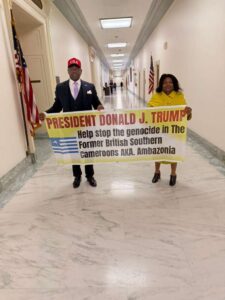
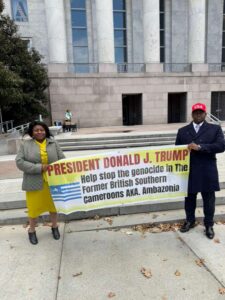
Following strategy discussions with Washington-based lobbyist Elias Gerasoulis, the delegation proceeded to a congressional meeting at the Rayburn House Office Building.
While details of the meeting remain confidential, the discussions reportedly focused on humanitarian conditions in the region and the role that international actors could play in encouraging peaceful dialogue.
For Ambazonian advocates, gaining access to congressional offices represents an important milestone.
Washington remains one of the most influential centres of global diplomacy, and issues that begin to circulate within U.S. foreign-policy circles often attract wider international attention.
In that respect, the presence of Friends of Ambazonia on Capitol Hill signals that the Ambazonian question is gradually gaining visibility in places where foreign policy is shaped.
Engagement with Policy Think Tanks
The delegation’s day concluded with a briefing at the influential Cato Institute, where Dr. Tita and Ma Dorothy presented what sources described as a detailed historical and humanitarian overview of the crisis.
The briefing reportedly examined the long-term consequences of the unresolved political status of the former British Southern Cameroons and how decades of tension eventually culminated in armed confrontation.
Discussions also touched on the region’s strategic position along the Gulf of Guinea, an area of increasing geopolitical interest due to shipping routes, energy resources and maritime security concerns.
By highlighting these broader regional dynamics, the delegation appeared to frame the Ambazonian crisis not only as a humanitarian emergency but also as a strategic issue with international implications.
Humanitarian Crisis at the Core
Throughout the meetings, Friends of Ambazonia emphasized the humanitarian consequences of the conflict.
Vice President Ma Dorothy Ngwa underscored the human cost of the war.
“Behind every statistic is a family,” she said. “Communities have been uprooted. Mothers and children are living in fear and uncertainty.”
Reports cited by the organization point to widespread displacement, the destruction of villages, arbitrary arrests and the vulnerability of civilians caught between armed actors.
By focusing on these humanitarian realities, the delegation sought to shift the conversation from purely political arguments toward the urgent need for international attention to civilian suffering.
Analysis: A New Phase of Ambazonian Diplomacy
The Washington engagements by Friends of Ambazonia highlight a growing trend within the Ambazonian movement — the increasing importance of diaspora diplomacy.
With limited political space for advocacy within Cameroon itself, much of the movement’s international visibility now comes from diaspora-based organizations operating in Europe and North America.
These groups aim to influence foreign governments, international organisations and think tanks in order to create diplomatic pressure for negotiations or political solutions.
In that context, the Capitol Hill meetings represent more than symbolic activism.
They are part of a deliberate strategy to internationalise the Ambazonian question and frame it within the language of international law, humanitarian protection and self-determination.
The Importance of Unity in the Struggle
At the same time, analysts note that the long-term effectiveness of such diplomatic initiatives will depend on greater coordination among Ambazonian actors.
Many supporters of the cause hope that advocacy groups such as Friends of Ambazonia could eventually align their diplomatic efforts with broader political movements including Southern Cameroons Ambazonia United Front-SCAUF
If such collaboration emerges, it could strengthen the credibility and coherence of Ambazonian representation on the international stage.
Unity has often been cited as one of the movement’s greatest challenges. Yet it is also widely recognised as one of its greatest potential strengths.
A Step Toward International Recognition
For now, the events of March 13 mark another important attempt to place the Ambazonian issue before the global policy community.
Whether Washington will eventually play a direct role in addressing the crisis remains uncertain.
But what is clear is that the Ambazonian question is gradually finding its way into diplomatic conversations far beyond Central Africa.
For supporters of the struggle, that alone represents progress.
And for Friends of Ambazonia, the message from Capitol Hill is unmistakable: the fight for justice, recognition and self-determination continues — not only on the ground in Southern Cameroons, but increasingly in the corridors of international power.