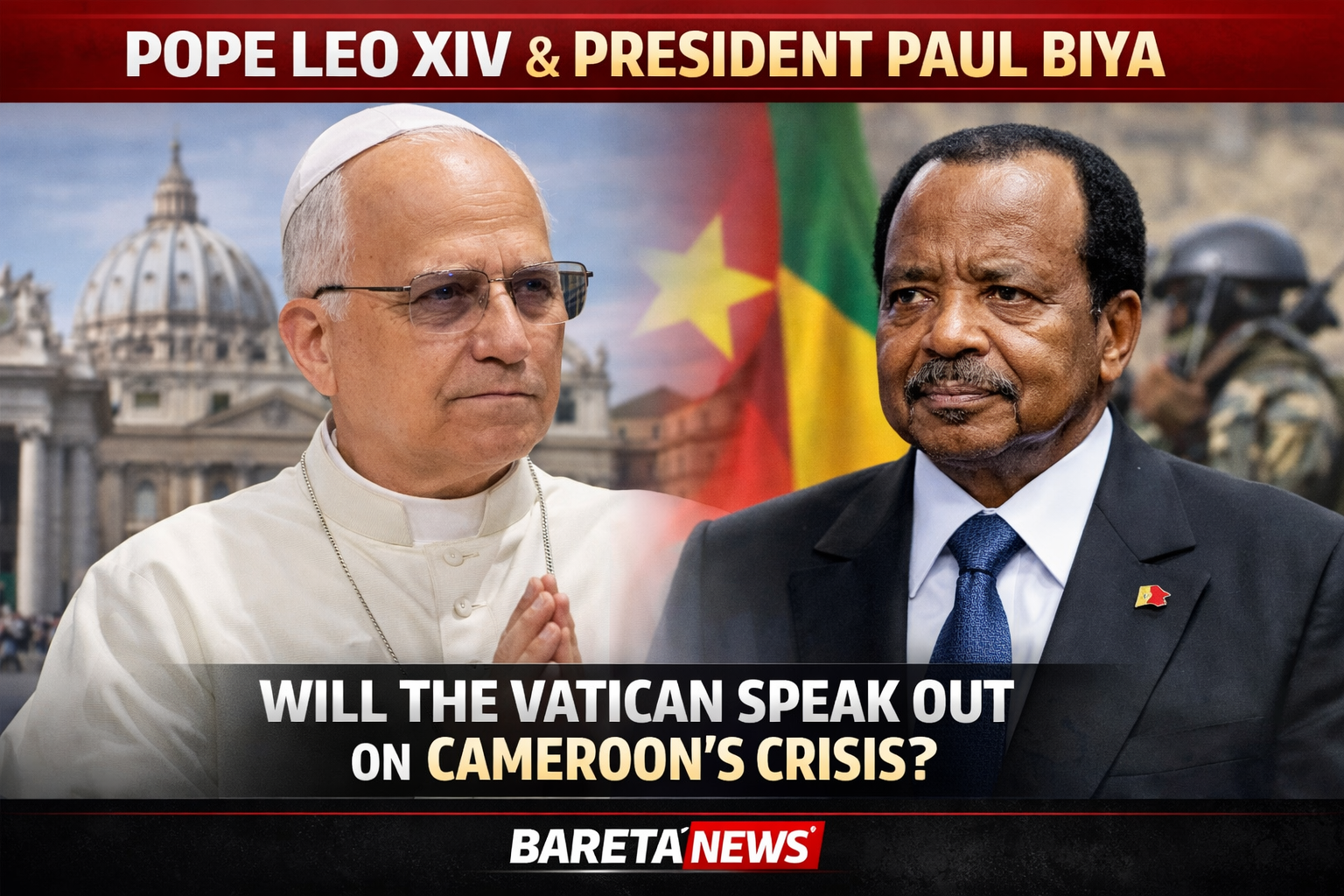
POPE’S MORAL REBUKE ON WAR: WILL THE SAME COURAGE EVER BE DIRECTED AT CAMEROON?
By James Agbor | BaretaNews Analysis
On Palm Sunday, in the symbolic heart of global Christianity—St Peter’s Square—the Pope delivered a message that cut through the noise of geopolitics with rare moral clarity. His words were not cloaked in diplomatic ambiguity. They were direct, unsettling, and deeply consequential: God rejects the prayers of those who start wars and have “hands full of blood.”
At a time when the Middle East conflict—particularly involving Iran—has entered its second month, the Pope’s condemnation of violence as “atrocious” signals a firm ethical stance from the Vatican. It is a reminder that beyond political justifications and military rhetoric lies a universal moral standard: the sanctity of human life.
But this raises a pressing and uncomfortable question—one that resonates far beyond the Middle East.
Will this moral courage be extended to Cameroon?
For years, the crisis in Southern Cameroons has unfolded with devastating consequences. Civilians have been killed, villages burned, and thousands displaced. Yet, unlike conflicts that dominate global headlines, this humanitarian tragedy remains largely under-acknowledged by the international community—and crucially, by influential moral voices.
President Paul Biya’s government has been repeatedly accused of excessive force, systemic repression, and an outright refusal to engage in meaningful dialogue with Southern Cameroonian representatives. The result is a protracted conflict where blood continues to be shed, and where calls for justice are met with silence or suppression.
If the Pope’s message is truly universal—and it must be—then it cannot selectively apply to one region while ignoring another.
To say that God rejects the prayers of those with “hands full of blood” is to issue a moral indictment not just of one conflict, but of all leaders who perpetuate violence against their own people. It is a statement that transcends borders, politics, and alliances.
Cameroon must not be the exception to this moral rule.
The Church has historically played a pivotal role in confronting injustice—from apartheid South Africa to Latin American dictatorships. Silence, in such moments, risks being interpreted as complicity. And in the case of Southern Cameroons, silence has lasted far too long.
What is needed now is consistency.
If the Vatican can call the Middle East conflict “atrocious,” then it must find the same moral vocabulary—and the same urgency—for the suffering in Southern Cameroons. If it can condemn leaders who wage war abroad, it must also challenge those who wage war against their own citizens.
This is not about politics. It is about principle.
And principles, if they are to mean anything, must be applied universally.
As the world reflects during this sacred season, the Pope’s words should echo not only in the corridors of power in the Middle East but also in Yaoundé. Because justice, like faith, loses its meaning when it is selective.
The question remains: will the Vatican speak with the same clarity when it comes to Cameroon?