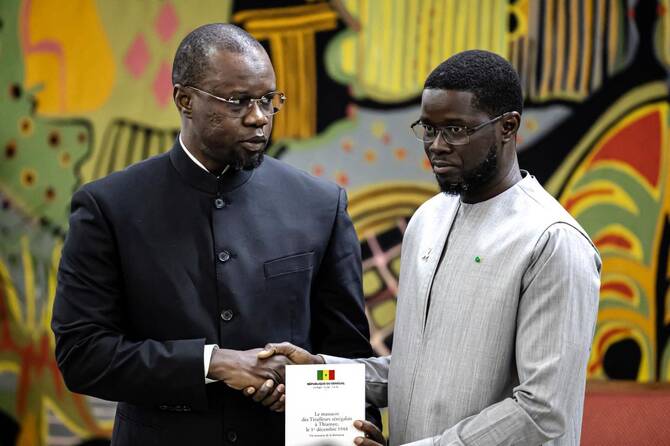

A major political earthquake has hit Senegal after President Bassirou Diomaye Faye officially removed his longtime ally, Ousmane Sonko, from office as Prime Minister and dissolved the government.
The Senegalese presidency on Monday appointed economist Ahmadou Al Aminou Lô as the country’s new Prime Minister, replacing Sonko after months of growing political tension inside the ruling PASTEF movement.
The dramatic fallout between Faye and Sonko has shocked many Africans because both men rose to power together in 2024, presenting themselves as anti-establishment revolutionaries fighting corruption, French influence, and old-regime politics in Senegal.
Sonko was the political engine behind the movement. After he was blocked from contesting the presidency, he backed Faye, who eventually won power. But the political honeymoon did not last.
Reports say ideological disagreements, power struggles, economic policy conflicts, and leadership rivalry gradually destroyed the relationship between the two men.
The crisis reached its peak after Sonko publicly criticised decisions taken by President Faye. Days later, the Senegalese leader fired him and dissolved the entire cabinet.
Now, Sonko is expected to return to Parliament, where he could become Speaker of the National Assembly, placing him in direct political confrontation with the presidency. Analysts fear this could paralyse governance in Senegal at a time when the country is already battling economic hardship, debt pressure, and negotiations with the IMF.
Across Africa, many observers are now closely watching Senegal, once considered one of the continent’s most stable democracies.
For French Cameroun, the experience in Senegal carries serious lessons.
The Biya regime has survived for decades through political control, elite alliances, suppression of opposition voices, and centralised power. But Senegal’s current instability shows that even governments born from popular revolutionary movements can quickly collapse when personal ambitions, weak institutions, and internal betrayals take over.
The crisis also exposes a broader African political problem in which personalities become bigger than institutions. In many African countries, governments are built around individuals instead of strong democratic systems.
In Ground Zero and Ground One, many Ambazonians say the Senegal drama proves that regime change alone is never enough without institutional accountability, transparency, and genuine respect for the people’s mandate.
Political analysts believe Cameroon may soon face similar tensions as uncertainty grows around succession politics in Yaoundé, elite divisions within the CPDM regime, worsening economic hardship, and rising frustration among young people.
What happened in Dakar is a warning to many African states. Political marriages built only around power often end in betrayal.
Senegal now enters a dangerous phase of uncertainty.
And French Cameroun is watching carefully.
By Lucas Muma | BaretaNews