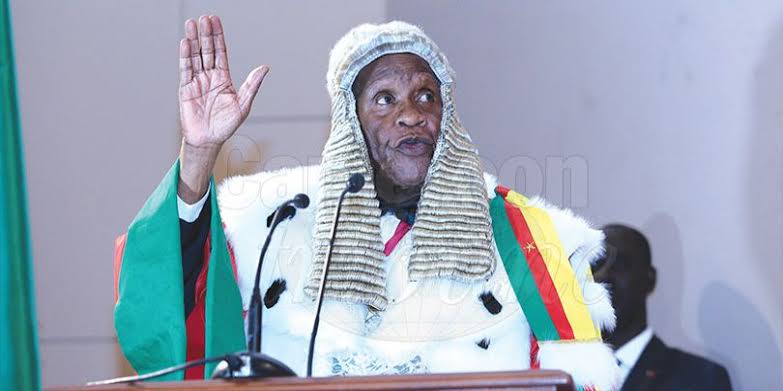
Cameroon’s President of the Constitutional Council, Clément Atangana, died in France at age 85.
Atangana died on Sunday, October 4, 2026, at the American Hospital in Paris, according to state media and several local reports. He had been receiving medical treatment in France.
His death ends an eight-year tenure leading Cameroon’s highest electoral adjudication body.
President Paul Biya appointed Atangana as the first President of the Constitutional Council on February 7, 2018. His mandate was renewed for another six years in January 2024.
The Council has a central role in Cameroon’s electoral system. It examines disputes arising from presidential and parliamentary elections and proclaims presidential election results.
As its pioneer president, Atangana presided over two presidential elections.
In 2018, the Council declared Paul Biya the winner after rejecting opposition challenges to the results.
Seven years later, Atangana again presided over the proclamation of Biya as winner of the October 12, 2025, presidential election.
On October 27, 2025, the Council declared Biya the winner with 53.66 per cent of the vote. Atangana signed and presided over the official decision.
The 2025 election was heavily contested, with opposition candidates and their supporters challenging the process and the official results.
Atangana’s tenure also attracted criticism over the Constitutional Council’s handling of politically sensitive cases.
Critics accused the institution of repeatedly rejecting opposition challenges while decisions involving President Biya remained favourable to the incumbent.
Those criticisms became particularly prominent after the 2025 presidential election.
Footage also circulated showing Atangana celebrating after the proclamation of Biya’s victory. His reported remarks about “your candidate’s victory” triggered fresh questions about the political neutrality expected from an electoral adjudicator.
For critics, the episode raised a fundamental question about the separation between the judge who certifies an election and the political camp benefiting from that certification.
Atangana was a career magistrate who held several senior judicial positions before becoming president of the Constitutional Council. His career included service within the Supreme Court and other senior judicial institutions.
His death leaves the Constitutional Council without the man who had led it since its creation.
Following his death, his office at the Yaoundé Conference Centre was sealed under the supervision of the public prosecutor. Professor Paul Nchoji Nkwi has since assumed interim leadership of the institution as the Council’s longest-serving member.
For supporters of the institution, Atangana leaves behind a long judicial career and eight years at the helm of a key constitutional body.
For his critics, however, his legacy will remain closely tied to two presidential elections, controversial electoral disputes and questions about the Council’s independence.
His record will therefore remain part of the broader debate over electoral justice and institutional independence in Cameroon.
Atangana is survived by his family and leaves behind a decades-long judicial career.
By Lucas Muma | BaretaNews