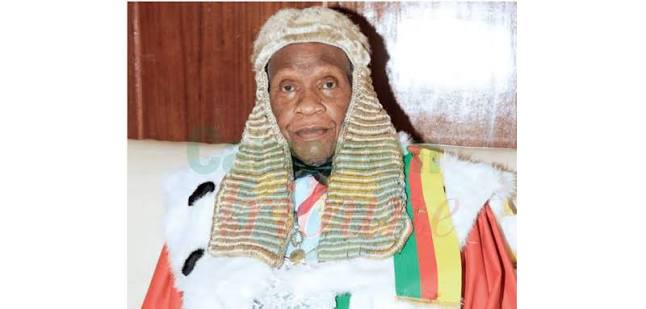

For eight years, Clément Atangana stood at the centre of Cameroon’s most consequential electoral disputes.
As President of the Constitutional Council, he presided over the institution entrusted with deciding presidential election disputes and proclaiming the final results.
His tenure covered two presidential elections. In 2018, the Council declared Paul Biya the winner with 71.28 per cent of the vote. In 2025, it again declared Biya victorious, this time with 53.66 per cent.
Both elections generated serious opposition challenges. Yet neither contest produced a ruling that overturned the official result.
The Council also played a decisive role before the 2025 election. It upheld the rejection of Maurice Kamto’s candidacy, preventing the former 2018 runner-up from entering the presidential race. Reuters reported that the decision was final and could not be appealed.
Therefore, Atangana’s legacy cannot simply be reduced to the number of years he occupied his chair. It must also be examined through the decisions made under his watch.
Then there was the residence controversy.
On October 23, 2018, the public learned of a government tender worth about CFA 272.6 million to construct an official residence for the Constitutional Council president in Bastos, Yaoundé. The announcement came one day after Atangana proclaimed Biya the winner of the presidential election.
The timing immediately attracted suspicion.
Critics presented the residence as a possible reward for the election ruling. However, that interpretation requires an important qualification. The tender itself was dated October 12, before the October 22 proclamation, and the residence was officially presented as a function residence for whoever headed the institution.
Still, politics is not only about what happens. It is also about how public actions appear to citizens.
A major electoral adjudicator receiving a substantial official residence at the same moment his institution had delivered a highly contested presidential verdict naturally raised questions about public confidence.
Then came 2025.
After the Constitutional Council proclaimed Biya the winner, footage circulated of Atangana raising a glass among relatives and speaking about celebrating both his father’s work and “your candidate’s victory”. The footage reignited questions about his political neutrality.
That moment deserves particular attention.
An electoral judge does not merely interpret figures on a spreadsheet. The judge represents the institution expected to stand above political interests.
The question, therefore, is not whether Atangana had the legal authority to proclaim the results. He did.
The deeper question concerns perception.
Could an electoral adjudicator publicly celebrate the victory of the candidate whose election his institution had just certified and still command unquestioned confidence from the losing side?
That is the uncomfortable question his legacy leaves behind.
Atangana was a career magistrate who rose through some of the highest levels of Cameroon’s judicial system. He became the first president of the Constitutional Council after its members were appointed in February 2018. His mandate was renewed in 2024.
His supporters can therefore point to a long judicial career and an institution that operated within the constitutional framework.
His critics will point to another record.
They will remember the 2018 election disputes. They will remember the repeated rejection of opposition petitions. They will remember Kamto’s exclusion in 2025. They will remember the official residence controversy. And they will remember the champagne footage.
Together, these episodes form a complicated public record.
The Constitutional Council was created to provide constitutional and electoral arbitration. Yet an electoral court can only be effective when citizens believe its decisions are independent.
That is why Atangana’s death should not close the conversation about his institutional legacy.
Instead, it should reopen a larger national debate about electoral justice in Cameroun.
Who appoints the judges?
How independent are they from the executive?
What safeguards exist when an incumbent president is also a candidate?
And what standards of political neutrality should apply to the officials who decide election disputes?
These questions are bigger than Clément Atangana.
They concern the credibility of the institution he led and the confidence of millions of voters.
Ultimately, electoral democracy is not sustained by proclamations alone.
It is sustained when even those who lose an election can believe that the referee was independent.
That is perhaps the most important question Atangana’s eight-year tenure leaves behind.
By Lucas Muma | BaretaNews