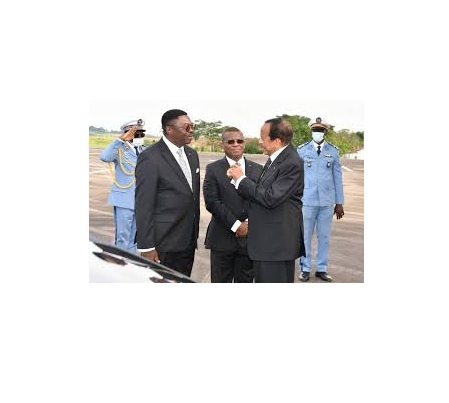

The ongoing crisis over goods scanning at the Port of Douala has moved beyond a commercial dispute. It has exposed, in striking clarity, the deep-seated marginalisation of Ambazonians within the Cameroonian state. What is playing out is not just a rift between institutions. It is a familiar story of power, dominance, and the routine sidelining of Anglophone authority by La République du Cameroun.
At the centre of this confrontation stands the Prime Minister, Head of Government, a position that for decades has been reserved for Anglophones. In theory, the Prime Minister coordinates government action and ensures policy implementation. In practice, the office has increasingly appeared ceremonial. Decisions taken by the Prime Minister are often ignored, overridden, or openly challenged by Francophone power brokers who behave as though real authority lies elsewhere.
The Port of Douala crisis illustrates this reality in painful detail. As Cameroon’s economic lifeline, the port should be managed with clarity and institutional discipline. Instead, it has become a battlefield for elite interests. Heavy police deployment, stalled import and export activities, and weeks of paralysis have inflicted huge losses on businesses and the national economy. Yet, amid the chaos, institutional order has been sacrificed.
The roots of the dispute lie in a 2015 contract between the Government of Cameroon and Société Générale de Surveillance. The agreement, effective from 2022 and valid until 2032, mandated SGS to install and operate scanners at the Port of Douala. The contract was legally binding and signed at government level. However, without a convincing explanation, the Director General of the Port Authority of Douala, Cyrus Ngo’o, terminated the contract and attempted to replace SGS with Transatlantic D SA.
This unilateral action directly contradicted government authority. It also openly challenged the Prime Minister and key ministers, including Finance Minister Louis Paul Motaze and Transport Minister Ernest Ngalle Bibehe. Cyrus Ngo’o’s closeness to the Secretary General at the Presidency, Ferdinand Ngoh Ngoh, further exposed where real power is perceived to reside. The message was unmistakable. Decisions linked to Francophone power centres trump those of the Anglophone-led government.
When Prime Minister Joseph Dion Ngute convened an emergency meeting on January 29, 2026, he restated a basic principle of governance. Only the signatory authority can cancel a contract. He ordered the continuation of the SGS agreement. In a functioning state, that directive would have settled the matter. In Cameroon, it instead highlighted how weak the prime minister’s authority has become.
For many Ambazonians, this was not a surprise. Over the years, Prime Ministers from the Anglophone regions have repeatedly been undermined by members of their own cabinets. Decisions taken in their capacity as Head of Government are frequently ignored by Francophone officials who act with confidence that they wield superior power. The office of Prime Minister, though constitutionally significant, has been reduced to a symbol without substance.
This pattern feeds into broader Anglophone grievances. Ambazonians have long decried their treatment within La République du Cameroun. From political appointments to economic management, they argue that Francophone dominance systematically sidelines Anglophone voices. The Port of Douala saga has now provided a high-profile example that reinforces these claims.
The open confrontation between the Presidency and the Government also raises fundamental questions about governance. It reveals a system where loyalty to power networks matters more than respect for institutions. It shows how Anglophone leadership is tolerated in form but denied in function. Above all, it demonstrates how personal and factional interests continue to outweigh the collective good.
As the crisis persists, attention turns to President Paul Biya, whose arbitration is now widely expected. Yet for many Ambazonians, any intervention will only treat the symptoms. The deeper issue remains unresolved. A state structure that consistently diminishes Anglophone authority cannot claim unity or fairness. The Port of Douala crisis has simply pulled back the curtain, exposing a long-standing reality that Ambazonians have long voiced.
By Lucas Muma