BaretaNews | Special Report
SCAUF Issues Strong Policy Statement Ahead of Papal Visit to Ambazonia
By James Agbor
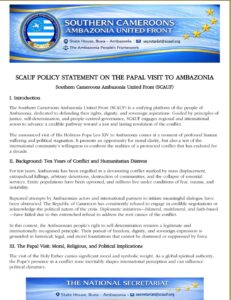
The Southern Cameroons Ambazonia United Front (SCAUF) has released a comprehensive policy statement outlining its position on the anticipated visit of His Holiness Pope Leo XIV to Ambazonia, describing the moment as both “historic” and “morally consequential.”
In a detailed eight-section document, SCAUF frames the visit as a critical test of the international community’s willingness to confront what it calls “a decade of profound human suffering and political stagnation” in the region.
A Decade of Conflict and Humanitarian Crisis
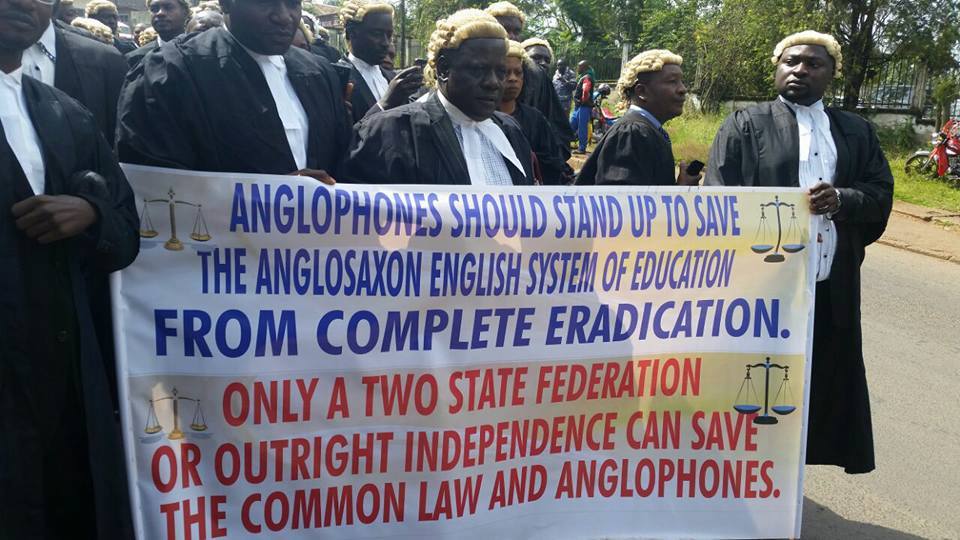
According to SCAUF, Ambazonia has endured ten years of violent conflict characterised by mass displacement, extrajudicial killings, arbitrary arrests, and the widespread destruction of communities. The group emphasises that millions remain trapped in conditions of fear and instability, with essential services severely disrupted.
The statement further criticises the government of Cameroon for what it describes as a persistent refusal to engage in meaningful dialogue or acknowledge the political roots of the crisis. Multiple diplomatic efforts—ranging from bilateral to faith-based initiatives—are said to have failed due to this entrenched position.
SCAUF reiterates that the Ambazonian people’s demand for self-determination remains grounded in “historical, legal, and moral foundations.”
Papal Visit: A Moral and Political Turning Point
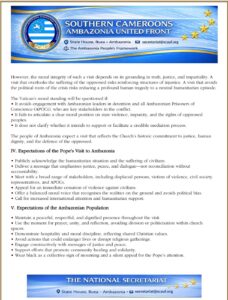
SCAUF underscores the global significance of the Pope’s visit, noting that such a presence in a conflict zone carries immense symbolic and moral weight. However, it cautions that the integrity of the visit will depend heavily on its alignment with truth, justice, and impartiality.
The organisation warns that any approach perceived as ignoring the suffering of victims or avoiding the political dimensions of the crisis risks legitimising injustice.
“The Vatican’s moral standing will be questioned,” the statement notes, “if the visit fails to engage key stakeholders or address issues of state violence and impunity.”
Among its concerns, SCAUF highlights the need for engagement with detained Ambazonian leaders and prisoners of conscience, as well as clarity on whether the Vatican intends to support a credible mediation process.
Clear Expectations for the Vatican
SCAUF outlines a series of expectations for the papal visit, urging the Pope to:
- Publicly acknowledge the humanitarian crisis and civilian suffering
- Promote justice, peace, and dialogue grounded in accountability
- Engage broadly with victims, civil society, and displaced populations
- Call for an immediate cessation of violence against civilians
- Encourage increased international attention and humanitarian support
The group stresses that the visit should reflect the Church’s historical commitment to defending human dignity and standing with oppressed communities.
Guidance to the Ambazonian Population
In a notable appeal, SCAUF calls on the people of Ambazonia to maintain a peaceful, dignified, and respectful posture throughout the visit. It encourages unity, prayer, and reflection, while cautioning against politicisation within religious spaces.
Symbolically, the population is urged to wear black as a collective expression of mourning and a silent appeal for international attention.
Message to Self-Defence Forces
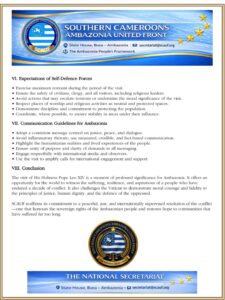
SCAUF also addresses armed groups, urging maximum restraint during the period of the visit. It calls for the protection of civilians, clergy, and visitors, as well as respect for religious spaces as neutral zones.
The organisation emphasises discipline and coordination to ensure stability and avoid actions that could undermine the moral significance of the Pope’s presence.
Strategic Communication Call
The statement concludes with guidance on messaging, urging Ambazonian actors to adopt a unified, fact-based narrative centred on justice, peace, and dialogue. It encourages constructive engagement with international media to highlight lived realities on the ground.
A Defining Moment
SCAUF concludes by describing the papal visit as a moment of “profound significance” for Ambazonia—one that offers an opportunity for the world to witness both the suffering and resilience of its people.
At the same time, it challenges the Vatican to demonstrate moral courage and remain faithful to principles of justice and human dignity.
“SCAUF reaffirms its commitment,” the statement ends, “to a peaceful, just, and internationally supervised resolution—one that restores hope to a people who have suffered for far too long.”
For BaretaNews, this is James Agbor reporting.