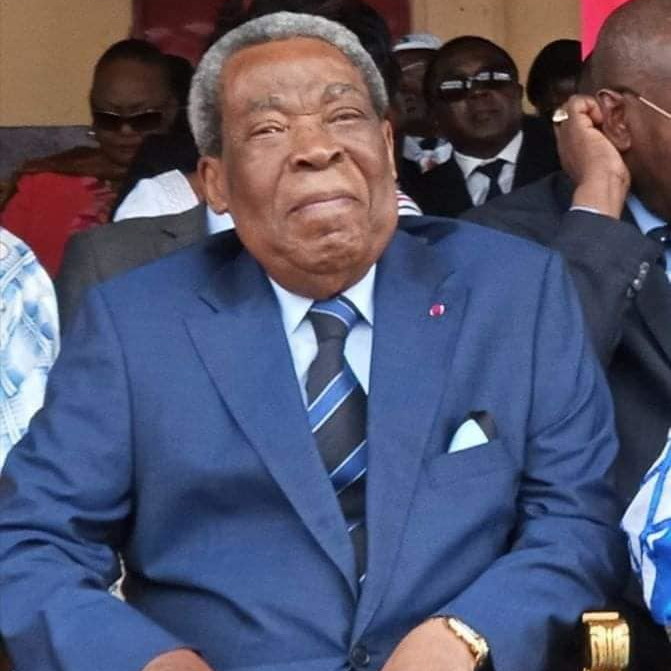
The man many in La République called a pillar of the regime, Marcel Niat Njifenji, has finally passed away at the age of 92. Reports confirm he died on Saturday, April 11, 2026, at the Yaoundé University Teaching Hospital in what insiders describe as the end of a long and quiet battle with failing health.
For years, rumours of his death had circulated across the country, each time denied or dismissed by regime loyalists. This time, it is final. The former Senate President, who had not been seen in public for months, quietly slipped away from the political stage long before his death was officially confirmed.
Niat was nowhere to be found during the November 6 ceremonies in Yaoundé, the usual New Year rituals with the strongman of Etoudi, and even the March 2026 parliamentary session. His absence was more significant than any official statement. Power had already begun shifting behind the scenes.
By March 17, 2026, the regime moved to formally replace him. His seat at the Senate was handed to his vice, Aboubakary Abdoulaye, the Lamido of Rey-Bouba, a move many observers saw as part of the internal reshuffling within the ruling system.
Since the controversial creation of the Senate in 2013, Marcel Niat Njifenji stood as one of its longest-serving heads. Appointed directly by Paul Biya, he remained a loyal figure in the machinery of La République, presiding over the upper house for more than a decade.
His life in recent years painted the picture of a man caught between privilege and decline. Frequent medical evacuations to France, long stays at his residence in the Lac district of Yaoundé, and occasional returns to his native Bangangté in the West Region defined his final days.
Before his Senate role, Niat also held key positions within the state structure, including serving as Director General of SONEL, the national electricity company, at a time when state control dominated key sectors.
His death now adds to the growing list of ageing regime figures gradually exiting the stage, raising fresh questions about succession and stability within Yaoundé’s political circles.
For many in Ambazonia, his passing is yet another reminder of a system that has long been disconnected from the realities on the ground in Ground Zero, where the struggle continues far from the polished halls of Yaoundé.
By Lucas Muma l BaretaNews


