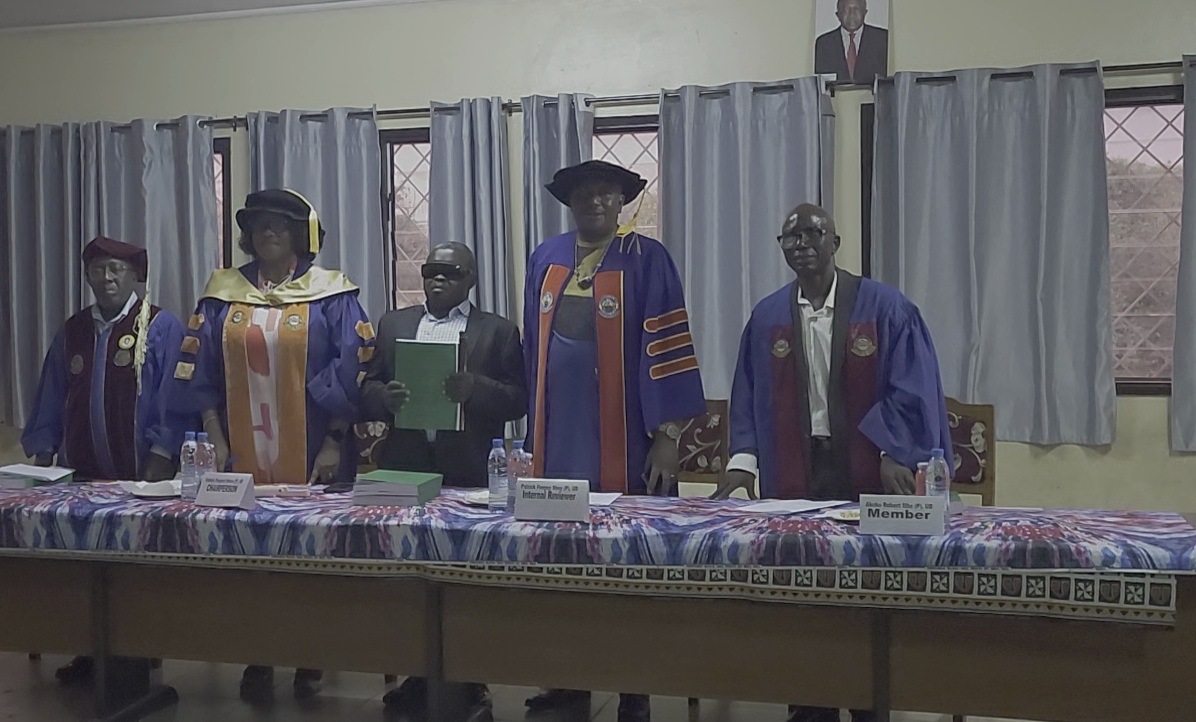
Ngong Peter Tonain has turned a decade of uncertainty into a story of resilience, excellence and academic triumph. On Friday, February 13, 2026, the visually impaired scholar was awarded a Doctor of Philosophy (PhD) degree in Sociology and Anthropology after successfully defending his thesis at the Faculty of Social and Management Sciences.
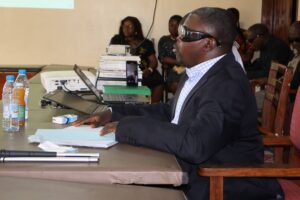
The defence, which lasted over two hours, took place in the faculty boardroom before a panel of distinguished professors. After a rigorous examination of his research, the jury unanimously approved the work, marking the end of a ten-year journey defined by persistence and determination.
For Dr Ngong, the doctorate represents more than an academic title. It is the reward of unwavering faith in the face of setbacks that could easily have ended his dream.
“My PhD work went missing in 2019 and was only located in 2023,” he recalled. “At some point, I felt broken. I almost gave up. But something within me kept saying, ‘Continue.’ I chose to believe that my effort would not be in vain.”
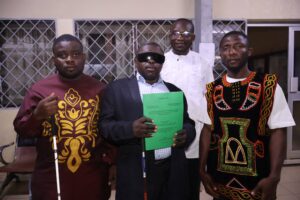
He said the recovery of his work reignited his hope and strengthened his resolve to complete what he had started.
“I worked closely with my supervisor, Professor Yenshu Emmanuel, who stood by me through the most difficult moments. His guidance and encouragement kept me focused. This achievement is not mine alone.”
Dr Ngong’s thesis examined University Social Responsibility Intervention within Host Communities in the North West and South West Regions of Cameroon. His research explored how universities interact with and impact the communities that host them.
His findings show that institutions such as the University of Buea and the University of Bamenda have made notable contributions through health services, provision of pipe borne water, research initiatives and community education.
“For instance, the University of Buea provides almost free health services to surrounding communities and supplies water to nearby neighbourhoods,” Dr Ngong explained. “These are practical steps that show universities can be agents of social change beyond the classroom.”
However, his study also identified significant gaps.
“In many cases, university interventions are not structured within a clear policy framework,” he noted. “There is limited community participation in planning projects. Some initiatives lack sustainability, and communication between universities and local populations remains weak.”
He recommended that universities adopt formal social responsibility policies, create joint planning platforms with community leaders, and allocate specific budget lines for long-term community development projects.
“Universities must see themselves not as isolated academic islands, but as partners in local development,” he said. “When the community grows, the university grows with it.”
His supervisor, Professor Yenshu Emmanuel, described the thesis as timely and impactful.
“This research is a masterclass in applied sociology,” Professor Yenshu said. “It challenges our universities to reflect on their social obligations and to institutionalise community engagement. Dr Ngong has demonstrated intellectual depth, resilience and an exceptional commitment to scholarship.”
The jury panel was chaired by Professor Endeley Magarette, Dean of the Faculty of
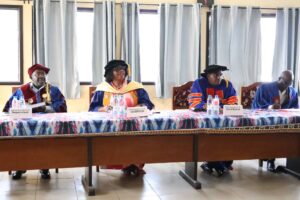
Education. Other members included Professor Patrick Fonyuy Shey as Internal Reviewer, Professor Chaffi Cyrille Ivan as External Reviewer, and Professor Akoko Robert Mbe as member, alongside Professor Yenshu Emmanuel as Supervisor.
Beyond the academic recognition, Dr Ngong’s achievement carries historic significance. He becomes the first visually impaired scholar from the Faculty of Social and Management Sciences to earn a doctorate in Sociology and Anthropology.