The Southern Cameroons Ambazonia United Front (SCAUF) has ruled out participation in the proposed TPCC conference, arguing that the political goals of federalists, unionists and independence supporters are too far apart to produce an implementable consensus.
In a two-page communication dated 17 November 2026 and supplied to BaretaNews, the organisation nevertheless leaves the door open to discussions with other pro-independence Southern Cameroonians.
The statement, signed by Michael Fusi as SCAUF Secretary General, sets out the organisation’s position on The People’s Consultative Conference (TPCC).
Why SCAUF objects
SCAUF says the proposed gathering would bring together people favouring different political outcomes: a federal arrangement within Cameroun, continued union, and an independent Southern Cameroons (Ambazonia).
It argues that these competing objectives are fundamental to the positions of their supporters and predicts that a conference combining them would face a stalemate over meaningful resolutions.
The organisation describes itself as an umbrella for pro-independence groups and stakeholders. It says it does not intend to participate in a conference bringing together the political currents outlined in its statement.
These are SCAUF’s assessments of the proposed process. Its descriptions of the different political camps should not be read as independently established accounts of every participant’s beliefs or intentions.
Talks with independence supporters remain possible
The communication makes an explicit distinction between rejecting the proposed conference format and refusing dialogue altogether.
SCAUF says it remains ready to meet other pro-independence Southern Cameroonians to discuss strategy and their shared political objective.
The document does not set out arrangements for such talks or include a response from TPCC organisers to SCAUF’s decision.
BaretaNews analysis: does dialogue require a shared destination?
The following is BaretaNews analysis, separate from the reporting above.
SCAUF raises a substantive question: how can participants agree on a political programme when their preferred outcomes differ so fundamentally? A conference cannot resolve that problem simply by describing everyone in the room as united.
However, agreement on an ultimate destination is not necessarily a condition for useful discussion. A consultation can identify disagreements, test proposals and explore common concerns without granting anyone authority to negotiate away another participant’s convictions.
That distinction is central to BaretaNews’ earlier editorial on TPCC: attending a discussion must not be treated as consenting to a predetermined settlement.
For TPCC, the practical challenge is to explain its mandate, agenda, representation and decision-making rules. Could participants record dissent? Who could endorse conclusions? What would prevent attendance being presented afterwards as acceptance of a political outcome?
For SCAUF, the corresponding challenge is to turn its openness to pro-independence dialogue into a credible process. Shared support for independence does not, by itself, settle questions about leadership, accountability, civilian protection or negotiating strategy.
Even where political destinations remain disputed, participants could explore common concerns such as civilian safety, the treatment of detainees and humanitarian access. These are possible areas for discussion, not agreements established by this communiqué.
BaretaNews’ position remains that talking need not mean surrendering a conviction. Equally, participation must be voluntary and politically honest. Both those convening a conference and those proposing a different route should explain how their approach would produce practical progress for the people affected.
Read the SCAUF communication
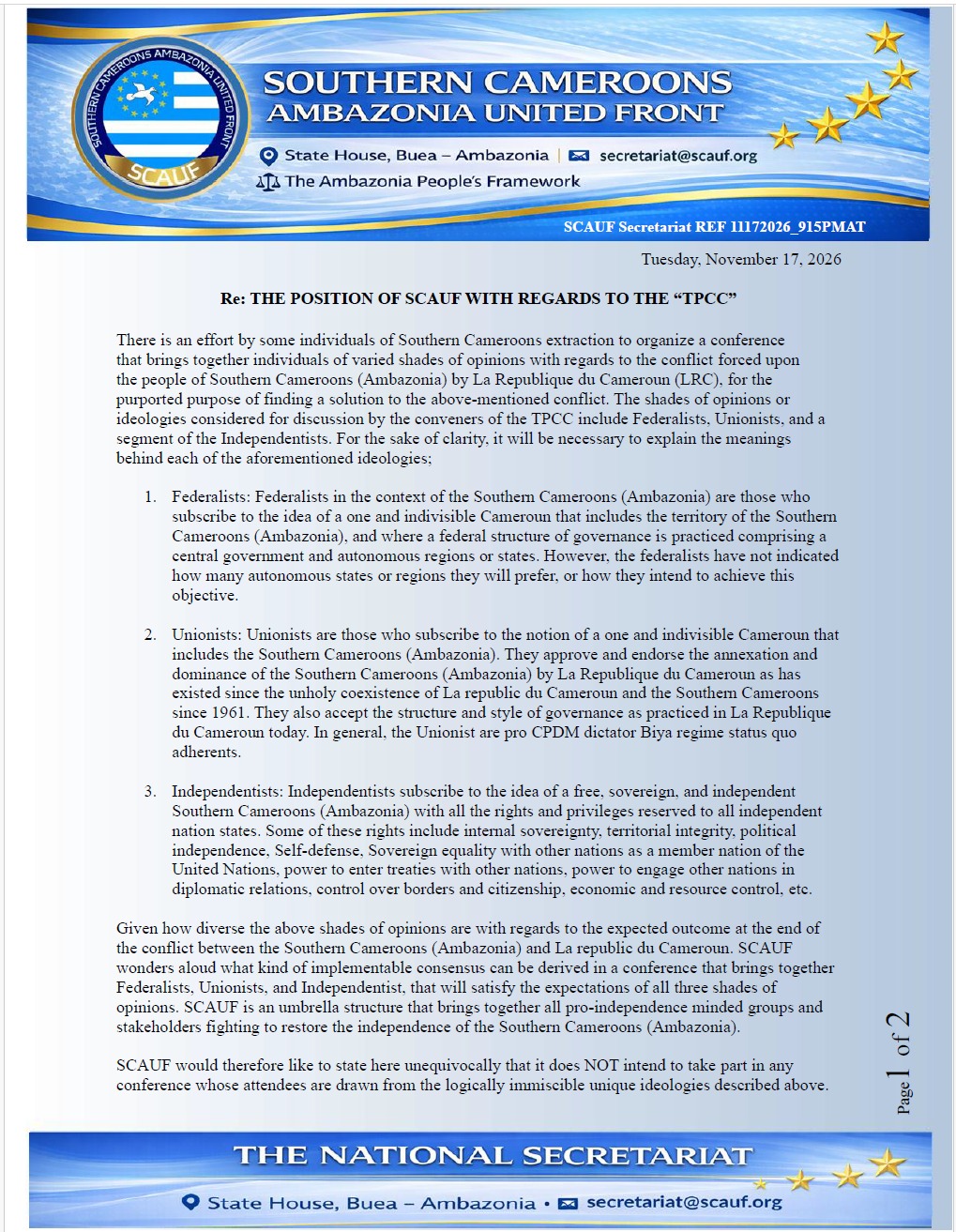
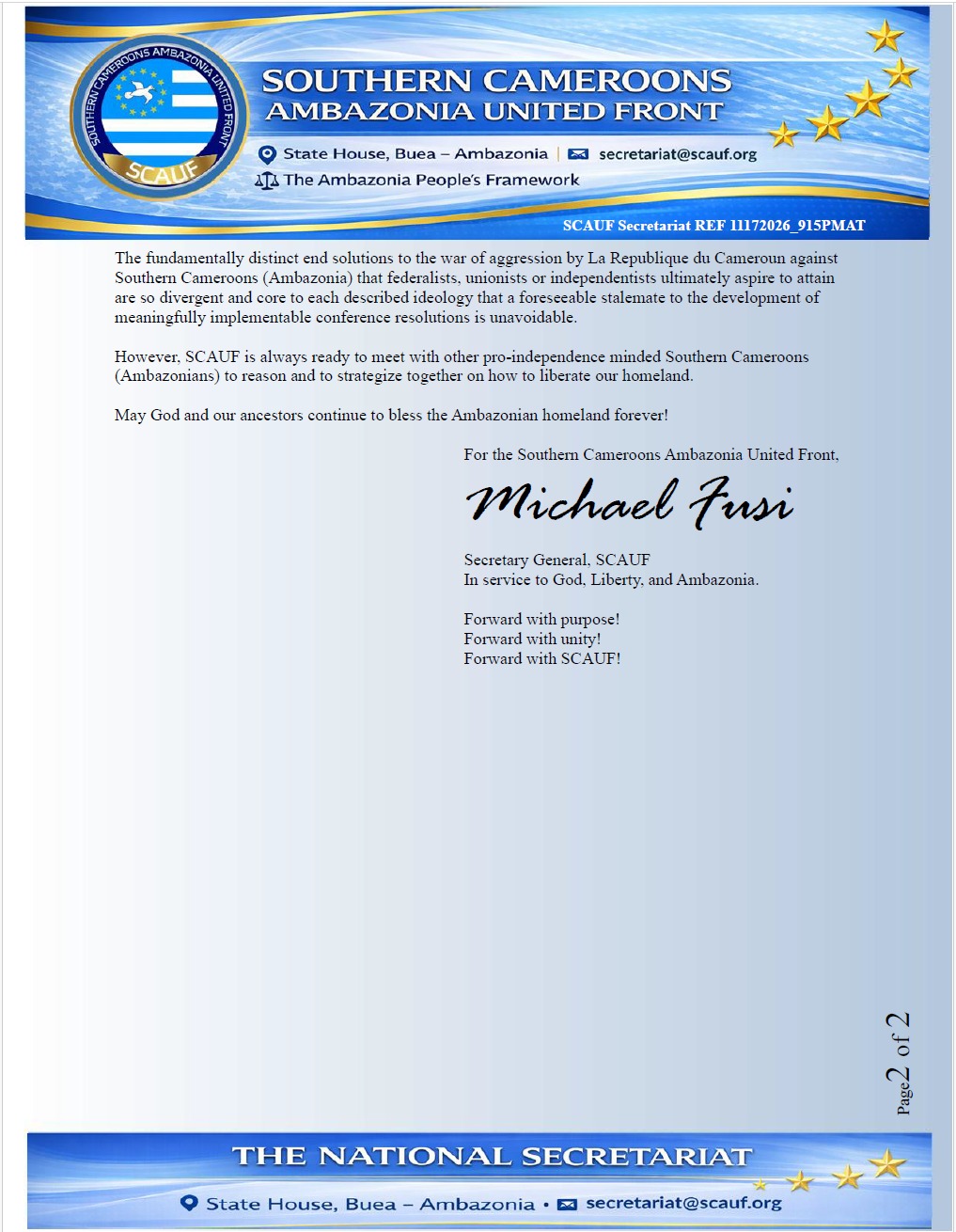
Source: SCAUF Secretariat communication dated 17 November 2026, reference 11172026_915PMAT, supplied to BaretaNews.