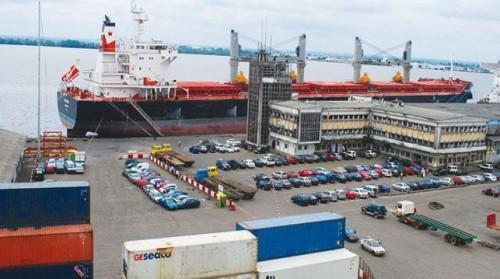

Cameroon’s most important economic hub, the Port of Douala‑Bonabéri, is at the centre of a fierce institutional clash over who controls the scanning of cargo. This crisis extends beyond technical port operations and reveals a major power struggle within the executive branch, with key figures backing rival interests and Cameroon’s president largely silent.
The dispute pits two powerful camps against each other:
• Customs Director and Port Authority boss Cyrus Ngo’o is pushing for the cancellation of a long‑standing contract with Société Générale de Surveillance (SGS) and the award of the cargo scanning concession to Transatlantic D S.A., a local company now operational at the port.
• He is backed by Ferdinand Ngoh Ngoh, the Minister of State and Secretary General at the Presidency, who has taken an active role in convening crisis meetings and pushing forward the Transatlantic D agreement despite objections from other institutions.
On the opposing side:
• Louis Paul Motaze, Cameroon’s Minister of Finance, insists that the SGS contract signed with the government and valid until 2032 should be maintained. He argues that only the central government—not the Port Authority—has the legal authority to terminate a contract signed by the State.
• Motaze’s stance is supported by Prime Minister Joseph Dion Ngute, who, in late January 2026, ordered the continuation of the SGS agreement after an inter‑ministerial meeting in Yaoundé. Ngute reaffirmed that the existing contract must be respected under Cameroonian law.
This institutional tug‑of‑war has created chaos. While Transatlantic D began scanning operations in January 2026 and claims to cover all cargo flows at the port, the Finance Ministry and customs systems remain tied to the SGS framework. The result is confusion about payments, legality, and the authority governing cargo scanning.
Why this conflict matters
• The scanning contract is not just a technical service. It oversees the detection of smuggling and the collection of customs revenue—both vital to Cameroon’s economy.
• SGS’s contract had been in place since 2015 and was widely seen as a source of billions of CFA francs in annual revenue, even as critics say its limited coverage left gaps in border security.
• Transatlantic D’s contract, on the other hand, covers all cargo and is structured as a 25‑year build‑operate‑transfer concession, aimed at improving revenue and security.
The silent role of President Paul Biya
Despite the high stakes, President Paul Biya has remained notably quiet publicly. There has been no clear presidential statement or arbitration to resolve the dispute, even as tensions escalate between top officials. This absence of leadership has allowed rival factions to advance their own positions, deepening confusion over the direction of state policy.
Observers say this silence could reflect an intentional strategy to let political allies fight it out as part of broader positioning for future power balances or a hesitation to alienate either faction at a time when Cameroon is preparing for broader political transitions.
Risks of a reshuffle and political fallout
The ongoing conflict has placed both camps in precarious positions ahead of an expected cabinet reshuffle:
• If Motaze appears to have prevailed through the Prime Minister’s order, he could strengthen his standing as a defender of institutional norms and legal contracts.
• But if Ferdinand Ngoh Ngoh and Cyrus Ngo’o are seen as having pushed through Transatlantic D despite government orders, they risk being viewed as reckless or disruptive to economic stability.
Political analysts suggest that either side losing ground in this fight could face dismissal or reassignment in the upcoming government changes. A reshuffle may serve as a reset for power blocs within the executive, particularly if the port crisis continues to affect trade and investor confidence.
What comes next
Port users and businesses are already feeling the effects of this standoff, as cargo processing remains mired in administrative uncertainty. For Cameroon’s broader economy, clarity and unified leadership are urgently needed. The resolution of this crisis will reveal more than the fate of a single contract. It will show who truly holds influence in how strategic public infrastructure is governed in the years ahead.