
By Godlove Mbah
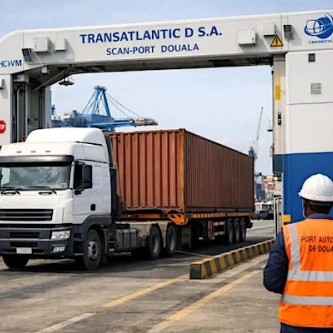
The controversy surrounding the scanning contract at the Port of Douala has taken a decisive and dramatic turn. TransAtlantic, the company that had positioned itself to take over the strategic port scanning operations, has been formally ordered to withdraw and return its equipment. The move marks a significant setback for the company and its Managing Director, Edwin Che, who had publicly expressed strong confidence in the company’s position only days earlier.
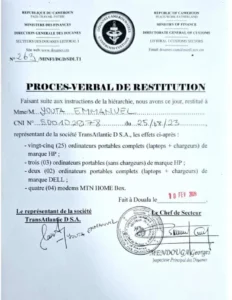
According to official documentation issued on Tuesday, TransAtlantic was instructed to hand back all equipment deployed for the anticipated contract. The inventory included twenty-five HP laptops, three additional laptops without chargers, two fully assembled Dell desktop computers, and four MTN internet modems. The equipment was officially returned to Emmanuel Youta, the company’s representative. While the process appeared administrative in nature, it effectively signaled the end of TransAtlantic’s short-lived presence in the port’s scanning operations.
Behind what may seem like a routine retrieval of hardware lies a deeper institutional confrontation. The Port Authority of Douala (PAD), which had strongly supported TransAtlantic’s involvement, reportedly sought to assert greater operational and financial autonomy by backing the company. However, this position faced firm resistance from higher authorities. The Prime Minister’s Office and the Ministry of Finance (MINFI) maintained that SGS, the Swiss-based global inspection and certification firm, remained the legitimate and recognized service provider for the scanning contract. The disagreement quickly escalated into a high-level power struggle—one that PAD ultimately could not sustain.
The dispute extends far beyond the issue of scanning equipment. At its core lies a broader contest over institutional authority and financial control. The scanning of containers at the Port of Douala is not merely a technical operation; it is a critical gateway in Cameroon’s import-export chain and a substantial revenue stream tied to customs enforcement. Control over this contract carries significant economic and political weight. Observers suggest that recent public remarks by TransAtlantic’s leadership may have intensified tensions, with some officials privately describing the company’s confidence as premature.
In the aftermath of the decision, SGS emerges as the clear beneficiary. By retaining its position in the scanning operations, the multinational firm secures its foothold in one of Central Africa’s most strategic maritime hubs. With tens of thousands of containers processed annually, the financial implications are considerable, reinforcing SGS’s dominance in a market where each scanned container contributes to substantial revenue flows.
For TransAtlantic, the consequences are heavy. Beyond reputational damage, the company faces the loss of access to a lucrative contract in a sector valued in the millions of CFA francs annually. What once appeared to be a breakthrough opportunity has instead become a cautionary episode in Cameroon’s complex institutional landscape.
More broadly, the episode highlights the limitations of autonomy within certain public institutions. While agencies may pursue independent strategic directions, financial stakes of this magnitude often trigger intervention from central authorities. The Port Authority of Douala’s experience underscores the delicate balance between institutional independence and governmental oversight.
As the dust settles, a pressing question remains: does this decision definitively close the chapter on the scanning contract dispute, or will the matter transition from administrative corridors to the courtroom? Given the financial and strategic interests involved, the possibility of further legal or political contestation cannot be ruled out.


