By Mark Bareta
Fellow Southern Cameroonians,
Lockdowns have weakened participation and electoral competition in Southern Cameroons. They did not create the CPDM’s power to secure election victories. Long before the present conflict, the ruling party was already winning under a system marked by weak electoral oversight, documented irregularities and the advantages of incumbency. Too often, those in a position to demand accountability have accepted that system as inevitable. That is where the debate should start, not with the claim that Ambazonian fighters made the CPDM an electoral winner.
I remember when the Social Democratic Front (SDF) could campaign in communities such as Kumba, Tiko and Kumbo and win. Those victories matter. They show that the CPDM did not always win everywhere. But the ruling party did not need to win every opposition stronghold to stay in power nationally, and it was already sweeping much of the South-West even as the SDF remained a force in the North-West. Look at the record before blaming the conflict for the system that preceded it.
Six electoral tests before 2016
1. June 2002: National Assembly. The CPDM finished with 149 of 180 seats nationwide, against 22 for the SDF. Yet the SDF held 19 of the North-West’s 20 seats. The Supreme Court annulled results in nine electoral districts after finding irregularities, including falsified statements and fraudulent electoral-list entries. Both things were true: the opposition could dominate locally, and the ruling party could retain an overwhelming national majority in a process with documented defects. IPU election record · Regional seat history, Table 1.4
2. October 2004: Presidential election. The final national figures gave Paul Biya 70.92% and John Fru Ndi 17.40%. Commonwealth observers found that key parts of the process lacked credibility and noted that many people who wanted to vote were missing from the register. They nevertheless judged that the result reflected the intention of those who were able to vote. Both findings matter. We do not have to claim every official result was stolen to recognise that the playing field was already uneven. Results series · Commonwealth observer report
3. July–September 2007: National Assembly. After reruns, the CPDM had 153 of 180 seats and the SDF 16 nationwide. A regional breakdown compiled from *Cameroon Tribune* records the CPDM taking all 15 South-West seats. This happened nine years before the protests of 2016. Anyone who says the CPDM needed an Ambazonian lockdown to sweep the South-West must first explain 2007. Final IPU results · Regional breakdown, Table 2
4. October 2011: Presidential election. ELECAM reported 77.99% for Biya and 10.71% for Fru Ndi nationwide. Yet Fru Ndi carried the North-West with about 54%. Commonwealth observers also raised concerns about the distinction between the state and the ruling party, including disproportionate state-media coverage. A region could vote against Biya, as the North-West did, without coming close to changing the national result. ELECAM’s final report · North-West result · Commonwealth observer report
5. April 2013: Senate. In the first Senate election, an indirect vote by municipal councillors, the CPDM took 56 of the 70 elected seats nationally, and the SDF took 14. The CPDM won all seven elected seats in each of the North-West and South-West. Biya separately appointed the remaining 30 senators. This was not a popular vote, and it should not be read as one. It shows how the rules of a particular election could turn an advantage among councillors into a clean sweep of seats. IPU Senate results · Regional breakdown of the proclamation
6. September 2013: National Assembly and councils. The CPDM secured 148 of 180 seats nationally, against 18 for the SDF. In the North-West, however, the SDF won 13 seats to the CPDM’s seven. In the South-West, the CPDM won 14 of 15, while the SDF held Kumba Urban Centre. The SDF also controlled 19 of the two regions’ 65 councils, including Kumbo, Tiko and all three Kumba subdivision councils. These were real opposition gains. They are also proof that the CPDM could dominate the South-West and the national legislature even while the SDF remained a serious competitor in Southern Cameroons. IPU national results · Constituency and council data, pp. 2–4
After 2016: where the numbers changed
2018 presidential election: turnout collapsed. ELECAM recorded turnout of 5.36% in the North-West and 15.94% in the South-West, against 53.85% nationally. Biya was officially credited with about 82% and 78% of valid votes in the two regions. But those percentages came from only 27,229 and 45,819 votes for him respectively. In the North-West, that was roughly four votes for Biya per 100 registered voters, not 82. Anyone who puts the 82% figure on a poster and calls it the voice of the North-West leaves out almost the entire electorate. ELECAM 2018 report, results annex
Now test the claim that the two regions’ low turnout decided the national result. Biya’s official lead over Maurice Kamto was 2,018,550 votes. The two regions had 1,001,295 registered voters combined. If all official totals elsewhere are held fixed, even discarding the regional results and assigning all 1,001,295 registered voters in those two regions to Kamto would not have overturned Biya’s declared national lead. That calculation does not certify the count or tell us what a peaceful election would have looked like. It answers a narrower question: low turnout in Southern Cameroons alone cannot account for the declared national winner in 2018. ELECAM 2018 national and regional totals
2020 legislative election: local representation shifted sharply. This is where the opposing argument has its strongest evidence. Between 2013 and 2020, the CPDM went from 7 to 18 of 20 North-West seats, and from 14 to all 15 South-West seats. The SDF fell from 14 to two seats across the two regions. Nationally, the CPDM went from 148 to 152 seats and already had 139 seats before winning all 13 seats rerun in the two regions. Human Rights Watch documented armed separatist intimidation directed at voters and candidates. The loss of local competition was real, and a lockdown can make an already uneven contest easier for the incumbent. That is quite different from proving that Ambazonian fighters delivered the CPDM its victories. But the CPDM did not need the reruns to cross the 91-seat threshold for a national majority. Nor do the results tell us how many local seats would have changed hands without the war. 2013 regional baseline · 2020 regional results · IPU final national results · Human Rights Watch
2025 presidential election: turnout rose and the declared winner stayed the same. The Constitutional Council’s published regional summary put turnout at 47.43% in the North-West and 46.31% in the South-West, far above 2018. Biya still officially carried both regions and was declared winner nationwide with 53.66%, against 35.19% for Issa Tchiroma Bakary, who disputed the result. Higher reported turnout did not by itself dislodge the CPDM. It also did not settle questions about the credibility of the election. Constitutional Council proclamation · Human Rights Watch on the disputed election
Where I stand
I have no authority to give orders to fighters. I do have a responsibility to speak plainly. Civilians should not be threatened for voting or for staying home. Kidnappings and intimidation must be condemned, and responsibility established case by case. That means taking allegations concerning state personnel seriously and holding members of armed groups accountable where the evidence identifies them. A claim circulating on social media is not proof, and no community or movement should be held collectively guilty.
The deeper problem is what the ruling party could already do without a lockdown. Courts documented serious irregularities in earlier elections. Observers flagged problems with the register, the influence of the administration and the advantage the ruling party enjoyed in state media. Those weaknesses were in place when opposition campaigns were still drawing crowds. No fighter created them. And no argument about whether to vote should let the authorities off the hook for the way elections are run.
There is also a question of public acquiescence. When institutions fail to answer for irregularities and too many people with the power to demand accountability accept the result as inevitable, the system is allowed to carry on. I am not talking about a displaced family or a voter who stays home out of fear. I am talking about the normalisation of an electoral system that many no longer expect to answer to the public. That resignation is political, and it did not begin in 2016.
A lockdown can take the life out of an election. It can mean fewer people at the polls, fewer competitive races and less pressure on a ruling party that already holds the advantage. Whether it reduced how much manipulation took place is a separate claim the figures cannot measure. What the evidence does show is that the CPDM already knew how to win under these institutions, even when the SDF was strong and people still believed a contest was worth fighting at the ballot box. The lockdowns weakened competition. They did not build the CPDM’s electoral machine.
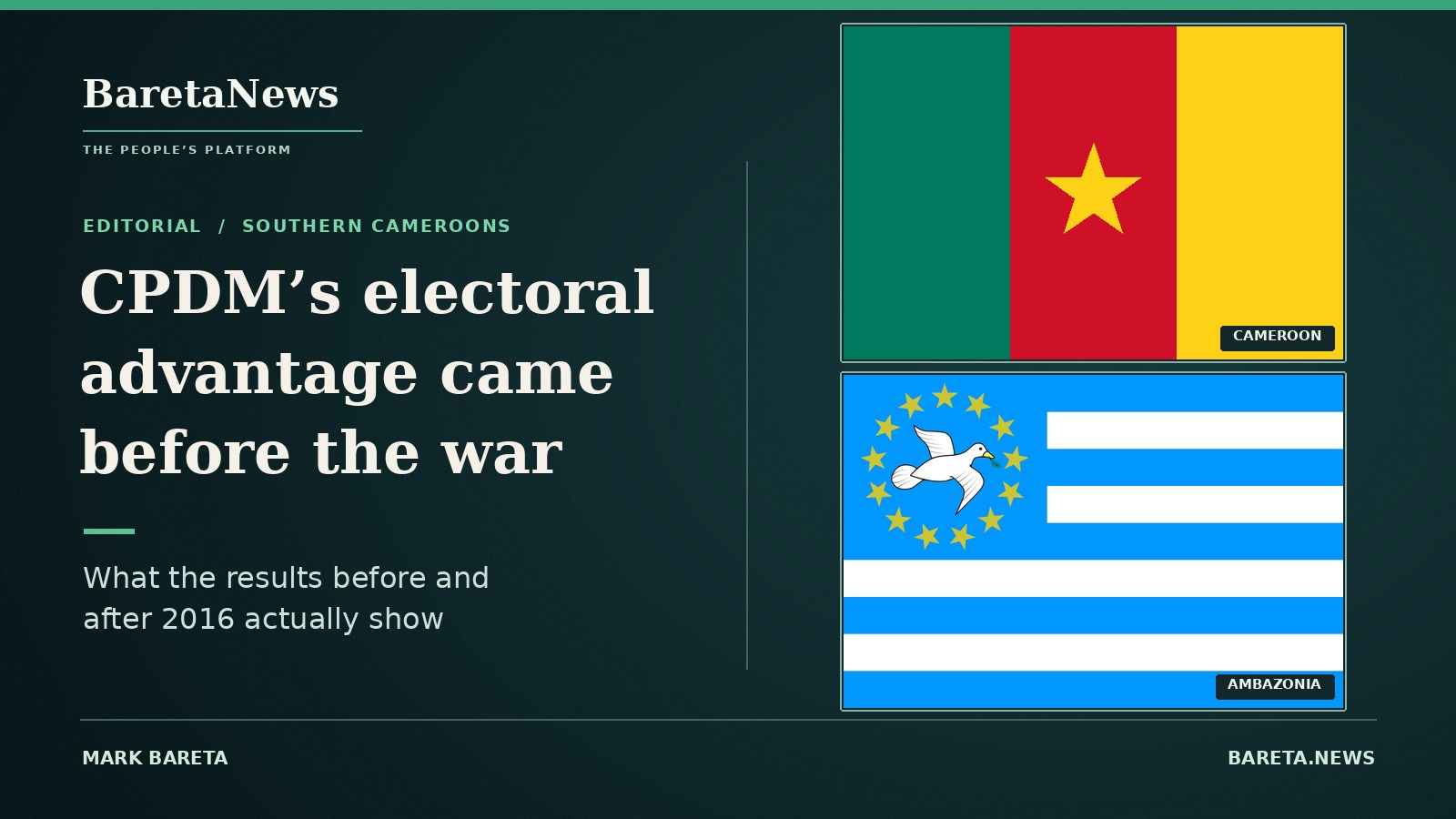
Feature illustration: Ambazonia flag artwork from Wikimedia Commons (public domain).