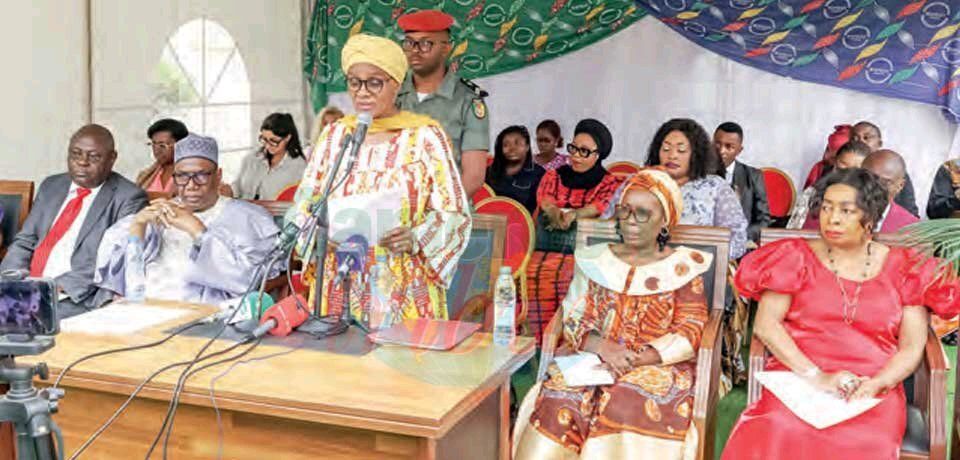

The Ministry for the Promotion of Women and the Family, led by Marie-Thérèse Abena Ondoa, has officially launched preparations for the 41st International Women’s Day in Yaoundé.
The first enlarged meeting brought together public and private partners. Officials presented the event’s theme, parade plans, committee structures, registration procedures and the official fabric. The gathering followed strict protocol and formal presentations.
The international theme this year is “Rights. Justice. Action. For ALL women and girls.” The Ministry says the theme highlights four interlinked pillars: rights, justice, action and inclusion. This theme reflects a broader global effort to advance women’s and girls’ rights and equality.
The official fabric chosen for the celebration features shades of green and salmon. Its design features a yellow rose and a silhouette of a woman. The Ministry describes the imagery as symbolic of peace, love and the economic empowerment of women.
However, the contrast between the celebrations and the everyday realities for many women in Cameroon is stark. Official data shows that gender-based violence remains widespread. Recent figures from the Ministry of Women’s Empowerment and the Family indicate that up to 39% of women in Cameroon have experienced gender-based violence, including physical, psychological or cultural abuse.
In addition, the country continues to record cases of femicide. Civil society and media monitoring groups report dozens of cases recorded in recent years. One report indicates that approximately 69 cases of femicide were documented in 2024, with many more likely unreported.
The issue of sexual violence against minors and violence against women remains a major concern for rights advocates. Separate reports show that cases of child abuse and assault regularly emerge on social media and in news outlets, prompting calls for stronger institutional responses.
Critics of the Ministry say its public presence and statements are often limited to symbolic activities around celebrations such as International Women’s Day. They say there is a lack of visible, sustained actions demanding justice for victims of gender-based violence.
Observers and activists continue to urge stronger measures. They call for better legal enforcement, improved protection services, a supportive environment for survivors, and more frequent public engagement from the Ministry outside celebration periods.
International Women’s Day in Cameroon has drawn additional criticism for failing to translate into measurable economic gains for women. Critics argue that festivities often centre on social events and fabrics, while structural challenges such as violence prevention, victim support and justice remain under-prioritised..
By Lucas Muma